About 142 minutes
The Glory of the Trenches — Background and Themes
World Events
32,600 recorded words. 0 minutes difference from this book's estimate.
View Gutenberg source #7515
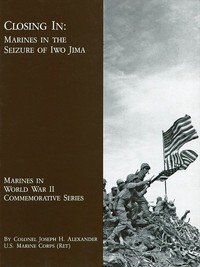
The catalog record for Closing In: Marines in the Seizure of Iwo Jima — A Closer Reading provides practical reading context through 32,563 words, 2 hr 22 min estimated reading time, and 23 detected text sections.
The text analysis averages about 18.6 words per sentence, while the detected sections provide another way to judge how the source is divided.
Project Gutenberg metadata also associates the work with “United States. Marine Corps -- History -- World War, 1939-1945,” connecting these edition facts with the source record’s subject description.
Explore this collection
These alternatives are selected using recorded categories and estimated reading time.
About 142 minutes
World Events
32,600 recorded words. 0 minutes difference from this book's estimate.
View Gutenberg source #7515About 144 minutes
World Events
33,015 recorded words. 2 minutes difference from this book's estimate.
View Gutenberg source #63637About 126 minutes
World Events
28,826 recorded words. 16 minutes difference from this book's estimate.
View Gutenberg source #15758Search stored excerpts and compare books → Choose by your preferences →
Choices use stored catalog measurements. Estimates vary with reading speed. A shared category is a catalog label, not a claim that two books have the same argument or literary quality.
Search reads excerpt text stored with this catalog and links to its associated Gutenberg record. The connection is stored in the site database; this tool does not recheck that every excerpt is word-for-word identical to that external record. Excerpt search does not cover every chapter and does not verify historical publication dates.
Catalog snapshot checked: 2026-09-25. Coverage: 91 public books, 91 available source excerpts.
Read the complete public-domain text at its original source.
Read on Project GutenbergColonel Joseph H. Alexander’s Closing In: Marines in the Seizure of Iwo Jima opens not with the iconic flag-raising but with the grim reality of 4 March 1945, when assault elements of three Marine divisions were “exhausted, their combat efficiency reduced to dangerously low levels.” The catalog subjects—United States Marine Corps history and the Battle of Iwo Jima—accurately frame the work, but the excerpts reveal a narrower focus: the operational and tactical challenges of seizing a heavily fortified island. Alexander, a retired Marine colonel, writes from an insider’s perspective, emphasizing command decisions, logistical constraints, and the frustrations of supporting arms.
The excerpts repeatedly highlight a defining feature of the Iwo Jima battle: the Japanese defenders fought from an extensive tunnel network, rarely exposing themselves. Alexander quotes Captain Fields of the 26th Marines: “The Japs weren’t on Iwo Jima, they were in Iwo Jima.” This observation is reinforced by Richard Wheeler’s description of a battlefield where one side fought “wholly above the ground and the other operating almost wholly within it.” The text notes that American aerial observers saw “thousands of figures” on one side and a seemingly deserted landscape on the other, with simultaneous troop movements in the same territory—one on the surface, one in tunnels. This subterranean warfare made traditional tactics ineffective and forced Marines to adapt.
A recurring theme in the excerpts is the inadequacy of air support during the early drive north. Alexander reports that the 3d Marine Division complained the Navy’s assignment of “eight fighters and eight bombers on station” was “entirely inadequate,” prompting General Cates to request replacement by the Strategic Air Force. Colonel Vernon E. Megee, Air Commander Iwo Jima, blamed “those little spit-kit Navy fighters up there, trying to help, never enough, never where they should be.” The text acknowledges that effective air support was doubtful given masterful Japanese camouflage, close-quarters combat, and overloaded request nets. Later, strikes improved with heavier bombs and better response time, but the battle continued to frustrate all supporting arms because the Japanese “almost never assembled legitimate targets in the open.”
Alexander’s narrative is punctuated by casualty figures and command requests. By D+6 (25 February), the V Amphibious Corps had already suffered 6,845 casualties. General Schmidt made repeated requests for release of the 3d Marines, held in Expeditionary Troops reserve. The text describes small groups of Marines crossing runways with “the inescapable feeling he was alone in the middle of a gigantic bowling alley.” Tanks were invaluable but many were lost. Resupply became nearly impossible. Schmidt managed to land corps artillery—two battalions of 155mm howitzers—whose fire eased pressure, along with naval gunfire. Yet the Marines’ disappointment with air support persisted until later improvements. The excerpts show a commander grappling with attrition and resource allocation in a battle where gains were measured in yards.
Readers should note that the excerpts cover only the first two weeks of the 36-day battle, focusing on the central and southern sectors. Alexander’s account is part of a commemorative series, so it emphasizes Marine Corps operations and sacrifices. The text includes sidebars on specific weapons and units, such as the Japanese 320mm spigot mortar and the Marines’ Zippo tanks, which are not fully represented in the excerpts. For a complete picture, consult the full work, which likely extends to the bitter end and the campaign’s legacy.
There are books that stay with you not for their grand sweep but for how quietly they hold the mud and grit of human effort. Colonel Alexander’s monograph on Iwo Jima left me with that same feeling — the slow logistics, the exhausted men, the awful weight of decisions. It reminded me of another quiet companion, Lawrence and the Arabs — Reading Companion, where the desert’s emptiness felt just as heavy.
Capture what you thought, learned, and would like to remember.