About 142 minutes
Closing In: Marines in the Seizure of Iwo Jima — A Closer Reading
World Events
32,563 recorded words. 0 minutes difference from this book's estimate.
View Gutenberg source #49080
The Glory of the Trenches — Background and Themes can be approached with a clearer sense of reading commitment from its source measurements: 32,600 words, 2 hr 22 min estimated reading time, and 4 detected text sections.
The text analysis averages about 18.0 words per sentence, while the detected sections provide another way to judge how the source is divided.
Project Gutenberg metadata also associates the work with “World War, 1914-1918,” connecting these edition facts with the source record’s subject description.
Explore this collection
These alternatives are selected using recorded categories and estimated reading time.
About 142 minutes
World Events
32,563 recorded words. 0 minutes difference from this book's estimate.
View Gutenberg source #49080About 144 minutes
World Events
33,015 recorded words. 2 minutes difference from this book's estimate.
View Gutenberg source #63637About 126 minutes
World Events
28,826 recorded words. 16 minutes difference from this book's estimate.
View Gutenberg source #15758Search stored excerpts and compare books → Choose by your preferences →
Choices use stored catalog measurements. Estimates vary with reading speed. A shared category is a catalog label, not a claim that two books have the same argument or literary quality.
Search reads excerpt text stored with this catalog and links to its associated Gutenberg record. The connection is stored in the site database; this tool does not recheck that every excerpt is word-for-word identical to that external record. Excerpt search does not cover every chapter and does not verify historical publication dates.
Catalog snapshot checked: 2026-09-25. Coverage: 91 public books, 91 available source excerpts.
Read the complete public-domain text at its original source.
Read on Project GutenbergConingsby Dawson opens The Glory of the Trenches not with a battle scene but with a confession of his own unfitness for war: he could ride a horse but had never handled firearms and knew nothing of artillery. This self-deprecating voice, preserved from his earlier letters, sets the tone for a narrative that dwells less on military strategy than on the psychological shift from civilian to soldier. The book was composed while Dawson convalesced from a wound received near Lens in June 1917, and its structure—part memoir, part meditation—reflects the dual perspective of a man who has seen combat and now tries to make sense of it for those at home.
Dawson's account of his enlistment is marked by a wry, almost embarrassed honesty. He describes presenting himself at Kingston's Tête du Pont Barracks in winter, wearing spats and a velour hat—details that underscore his civilian awkwardness. The captain's dismissive glance and the sergeant's sarcasms are rendered with a precision that makes the reader feel the chill of the parade ground. Dawson does not inflate his own courage; he admits to buying an alarm clock out of fear of oversleeping, and to hiding in shadows while checking his watch. This unheroic self-portrait is deliberate: it establishes that the 'glory' he later finds is not in martial prowess but in something less visible.
The poem that prefaces the book, 'To You at Home,' introduces a recurring motif: letters as lifelines. Dawson describes runners carrying mail 'through the battle-smoke' and 'up Death Valley spouting flame,' and the anguish when no letters come. This attention to the postal service—mundane yet vital—typifies his focus on the small, human rhythms within war. The physical landscape is rendered in stark, sensory fragments: 'tortured, pockmarked plain,' 'gas lurks treacherously,' 'dead men clasp their wounds.' Dawson does not linger on gore for effect; instead, he uses such details to ground the reader in the environment that shapes the soldier's inner life.
The book is introduced by Dawson's father, W. J. Dawson, who explains how the work came to be: written during convalescence in London, after a wound that nearly cost the author his right arm. This editorial frame is unusual—a father vouching for his son's modesty, noting that Coningsby had not even reread his own published letters. The father's voice adds a layer of distance and tenderness, reminding us that the narrative we hold is a product of both survival and family mediation. It also signals that Dawson's reluctance to see his experiences as remarkable is itself a theme the book will explore.
Dawson's training at Kingston is a study in humiliation and adaptation. He is a 'temporary gentleman'—a wartime officer without the usual background—and the sergeants' disgust is palpable. Yet the narrative traces a quiet arc: from the man who nearly fled back to New York to the soldier who, months later, is taking part in a major offensive. Dawson does not dramatize this change; he lets the details speak. The alarm clock, the frozen parade ground, the advice from a stranger in the dark—these accumulate into a portrait of a civilian remade by circumstance. The 'glory' of the title, he suggests, lies not in heroics but in the ordinary man's capacity to endure and find meaning.
Readers approaching The Glory of the Trenches should expect a reflective, episodic work rather than a continuous battle narrative. Dawson's strength lies in his ability to render the interior landscape of a soldier—the doubts, the small comforts, the shift in perspective—without resorting to sentimentality. The book is best read as a companion to his earlier Carry On: Letters in Wartime, which it echoes in tone and theme. Pay attention to the recurring image of letters as a bridge between worlds; it is through this mundane detail that Dawson most effectively conveys the emotional reality of the trenches.
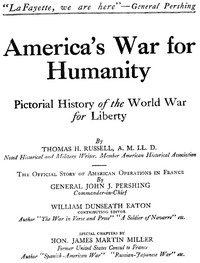
Reading about Dawson’s quiet transformation amid the mud reminded me of sitting with my grandfather, who never spoke of his own war but kept a worn copy of America’s War for Humanity — Context and Discussion on his shelf. I never opened it then, yet that same hush of unspoken brotherhood seemed to live between its pages, waiting. America’s War for Humanity — Context and Discussion felt like that memory—a doorway left ajar, not to be walked through, just acknowledged.
Your answers remain private and are stored only in this browser.