About 396 minutes
How Jerusalem Was Won Being the Record of Allenby's Campaign in Palestine — Background and Themes
World Events
91,047 recorded words. 206 minutes difference from this book's estimate.
View Gutenberg source #10098
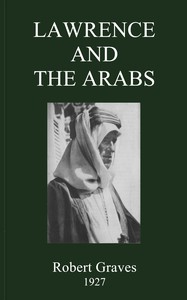
The source record for Lawrence and the Arabs — Reading Companion measures this digital text at 138,439 words, 10 hr 2 min estimated reading time, and 40 detected text sections.
The text analysis averages about 22.6 words per sentence, while the detected sections provide another way to judge how the source is divided.
Project Gutenberg metadata also associates the work with “Middle East -- History,” connecting these edition facts with the source record’s subject description.
Explore this collection
These alternatives are selected using recorded categories and estimated reading time.
About 396 minutes
World Events
91,047 recorded words. 206 minutes difference from this book's estimate.
View Gutenberg source #10098About 378 minutes
World Events
86,890 recorded words. 224 minutes difference from this book's estimate.
View Gutenberg source #11211About 374 minutes
World Events
85,886 recorded words. 228 minutes difference from this book's estimate.
View Gutenberg source #13045Search stored excerpts and compare books → Choose by your preferences →
Choices use stored catalog measurements. Estimates vary with reading speed. A shared category is a catalog label, not a claim that two books have the same argument or literary quality.
Search reads excerpt text stored with this catalog and links to its associated Gutenberg record. The connection is stored in the site database; this tool does not recheck that every excerpt is word-for-word identical to that external record. Excerpt search does not cover every chapter and does not verify historical publication dates.
Catalog snapshot checked: 2026-09-25. Coverage: 91 public books, 91 available source excerpts.
Read the complete public-domain text at its original source.
Read on Project GutenbergGraves opens his account by acknowledging that he wrote at Lawrence's invitation, with access to unpublished material from Seven Pillars of Wisdom and Revolt in the Desert. The narrative voice is that of a careful chronicler who must balance Lawrence's own version of events with independent observation. Graves notes that Lawrence, then serving as Aircraftman Shaw, cabled permission from India and supplied a list of sources, hoping the book would satisfy public curiosity before his return to civilian life. This framing establishes the biography as an authorized but not uncritical work.
Graves maintains a measured, reportorial tone throughout the excerpts, rarely inserting his own judgments. He describes Lawrence's reluctance to lead—'a task to which he was opposed on principle'—and his preference for letting Arabs run their own campaign. The prose is dense with specific detail: the camel Ghazala matched against El Jedha, the three camp-fires at night, the shamefaced men of Gasim's clan who rode out late. Graves lets these particulars carry the narrative weight, avoiding overt praise or criticism. When he does offer interpretation, it is hedged: Lawrence was 'a most unsuitable commander of a Bedouin raid' because leadership required 'a lifetime's training.' This restraint gives the account an air of documentary reliability.
The excerpts show a deliberate alternation between static, reflective passages and bursts of action. The encounter with the old man at Rumm—who murmurs about God and Love, a concept 'quite foreign' to Arabia—slows the narrative to a philosophical pause. Graves dwells on the puzzle this presents, then shifts abruptly to the ride's unpropitious start. The march itself is described in terms of friction: Zaal's expertise ignored by sullen chiefs, Lawrence riding 'up and down the column' to forge unity. Only at night, after 'hot bread and gazelle-meat,' does the pace ease into tactical discussion. This rhythm mirrors the stop-start nature of desert warfare, where long stretches of negotiation precede moments of violence.
Graves uses landscape and material culture to anchor the narrative. The well at Mudowwara station, the covered valley, the pilgrim railway—these are not backdrops but active elements in the campaign. Descriptions are terse: 'the village of date palms,' 'the ride to Akaba.' The maps by Herry Perry and illustrations by Eric Kennington are listed in detail, suggesting that visual documentation complements the text. Graves also notes the physical objects that define Lawrence's world: the motor-bicycle 'Boanerges,' the bust by Kennington, the armoured Ford in the desert. These details root the biography in a specific material reality, avoiding abstraction.
Graves repeatedly highlights Lawrence's discomfort with authority. He 'made a point of letting the Arabs run their own campaign as far as possible,' yet was forced into leadership by 'his freedom from tribal complications' and 'whole-hearted zeal.' The biography does not resolve this tension; instead, it accumulates instances of Lawrence's contradictory position—technical adviser turned de facto commander, outsider who mediates between jealous clans. Graves's treatment is notably unsentimental: he presents Lawrence's generosity and tact as practical assets, not virtues. The reader is left to weigh the costs of this reluctant leadership.
Graves's biography is best approached as a contemporary document rather than a definitive history. Because it was written with Lawrence's cooperation and under time pressure, it offers a unique perspective on how Lawrence wished to be seen in 1927. Readers may want to compare its account with Lawrence's own Seven Pillars of Wisdom and with later scholarship. The book's value lies less in its conclusions than in its accumulation of specific, often mundane details—the kind of evidence that resists easy interpretation.
Flipping through Graves’s account of Lawrence’s weary ascent among the Arab tribes, I found myself remembering a quieter book, one my grandfather kept near his armchair. The Discipline of War Nine Addresses on the Lessons of the War in Connection with Lent — A Closer Reading shares that same grave patience, the sense that endurance itself becomes a kind of prayer. Both speak of duty’s slow weight.
A brief reflection can help important ideas stay with you longer.