About 602 minutes
Lawrence and the Arabs — Reading Companion
World Events
138,439 recorded words. 263 minutes difference from this book's estimate.
View Gutenberg source #74014
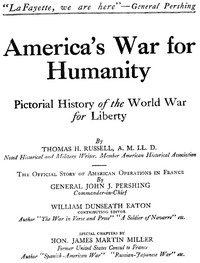
For America's War for Humanity — Context and Discussion, the stored edition analysis reports 198,807 words, 14 hr 25 min estimated reading time, and 20 detected text sections.
The text analysis averages about 23.0 words per sentence, while the detected sections provide another way to judge how the source is divided.
Project Gutenberg metadata also associates the work with “World War, 1914-1918,” connecting these edition facts with the source record’s subject description.
Explore this collection
These alternatives are selected using recorded categories and estimated reading time.
About 602 minutes
World Events
138,439 recorded words. 263 minutes difference from this book's estimate.
View Gutenberg source #74014About 396 minutes
World Events
91,047 recorded words. 469 minutes difference from this book's estimate.
View Gutenberg source #10098About 378 minutes
World Events
86,890 recorded words. 487 minutes difference from this book's estimate.
View Gutenberg source #11211Search stored excerpts and compare books → Choose by your preferences →
Choices use stored catalog measurements. Estimates vary with reading speed. A shared category is a catalog label, not a claim that two books have the same argument or literary quality.
Search reads excerpt text stored with this catalog and links to its associated Gutenberg record. The connection is stored in the site database; this tool does not recheck that every excerpt is word-for-word identical to that external record. Excerpt search does not cover every chapter and does not verify historical publication dates.
Catalog snapshot checked: 2026-09-25. Coverage: 91 public books, 91 available source excerpts.
Read the complete public-domain text at its original source.
Read on Project GutenbergThis volume, published during the war itself, presents itself as a 'Pictorial History of the World War for Liberty.' Its title page names Thomas H. Russell as author, but the contents include a full section by General John J. Pershing and contributions from other writers, making it a composite work. The dedication alone—addressed to soldiers, sailors, and 'the men of the armies and navies of nations allied with us'—reveals the book's explicit partisanship and its aim to rally support for the Allied cause.
The catalog subject 'World War, 1914-1918' is accurate, but the excerpts show the book is not a neutral record. It frames the conflict as a struggle between 'civilization' and 'barbarity,' a rhetorical stance common in wartime publications. Readers should approach it as a primary source for understanding how the war was presented to American audiences, rather than as an objective historical account.
The dedication runs to several paragraphs, each beginning with 'To those who...' It praises 'the higher ideals of humanity and civilization' and condemns 'the Teuton and the Turk' as 'the ruthless oppressor.' This language is not neutral; it actively constructs an enemy image. The dedication also honors women who 'endured in silence the pain of losses worse than death,' a gendered appeal to sacrifice. Such rhetoric is typical of wartime propaganda and gives the modern reader insight into the emotional register the book aims to strike.
The preface and presidential addresses (Wilson's 'Epochal Address' and 'War Address') further embed the work in official U.S. government messaging. The book does not question the war's necessity; it assumes it. This makes the volume valuable for studying how American civic and military leaders sought to justify and sustain public support for the war effort.
Interspersed with battle accounts are detailed technical explanations. For example, a passage on naval mines describes their construction: a 'spherical mine proper,' an 'anchor chamber,' and a 'plummet-weight.' The text explains the mechanism by which the mine is set to float at a selected depth. Similarly, the chapter on 'Aero-Military Operations' describes the development of a British aeroplane 'capable of rising from the ground at a very sharp angle' and reaching 150 miles per hour.
These technical sections contrast with the book's overall patriotic tone. They suggest the intended audience included not only general readers but also those interested in military technology. The inclusion of such details—along with maps and a photo gallery—indicates the book aimed to be both inspirational and informative, a combination that reflects the era's popular war literature.
The title page lists Russell as author, but the table of contents reveals contributions from multiple figures: General Pershing's 'Official Story of American Operations in France,' William Dunseath Eaton as 'Contributing Editor,' and special chapters by James Martin Miller. This collaborative structure suggests the book was assembled rapidly, likely to capitalize on public interest. The inclusion of Pershing's report gives the volume an official imprimatur, while Miller's prior work on the Spanish-American War connects it to earlier American conflicts.
The excerpts do not show how these parts are integrated, but the table of contents lists 35 chapters plus illustrations. The book's length—nearly 200,000 words—indicates a comprehensive scope, yet the editorial hand is evident in the repeated use of phrases like 'the most dreadful menace of all time.' Readers should note that the book is not a single author's analysis but a curated collection of texts, each with its own perspective.
This book is best read as a document of its time, not as a definitive history. Its value lies in what it reveals about wartime publishing, propaganda, and the construction of national memory. Pay attention to the interplay between technical detail and emotional appeal, and consider how the multiple authors' voices align or diverge. The volume offers a window into how Americans were encouraged to understand the war while it was still being fought.
That rainy afternoon, the 1918 volume sat heavy on my lap, its sepia maps and booming artillery prose filling the room with a distant thunder. But it was the quiet corners—the tiny photographs of soldiers’ faces—that lingered. Later, almost by accident, I found Two Colored women with the American Expeditionary Forces — A Closer Reading, and the same war felt suddenly more human, more intimate, less like history and more like a letter home.
Use these questions to collect your thoughts before moving on.