About 72 minutes
Why we are at war — Context and Discussion
World Events
16,349 recorded words. 13 minutes difference from this book's estimate.
View Gutenberg source #6870
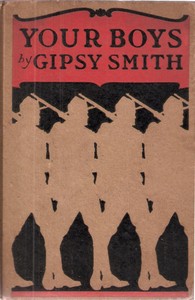
Your Boys — Reading Companion can be approached with a clearer sense of reading commitment from its source measurements: 13,534 words, 59 min estimated reading time, and 3 detected text sections.
The text analysis averages about 16.4 words per sentence, while the detected sections provide another way to judge how the source is divided.
Project Gutenberg metadata also associates the work with “World War, 1914-1918 -- Religious aspects,” connecting these edition facts with the source record’s subject description.
Explore this collection
These alternatives are selected using recorded categories and estimated reading time.
About 72 minutes
World Events
16,349 recorded words. 13 minutes difference from this book's estimate.
View Gutenberg source #6870About 72 minutes
World Events
16,343 recorded words. 13 minutes difference from this book's estimate.
View Gutenberg source #10967About 73 minutes
World Events
16,740 recorded words. 14 minutes difference from this book's estimate.
View Gutenberg source #10589Search stored excerpts and compare books → Choose by your preferences →
Choices use stored catalog measurements. Estimates vary with reading speed. A shared category is a catalog label, not a claim that two books have the same argument or literary quality.
Search reads excerpt text stored with this catalog and links to its associated Gutenberg record. The connection is stored in the site database; this tool does not recheck that every excerpt is word-for-word identical to that external record. Excerpt search does not cover every chapter and does not verify historical publication dates.
Catalog snapshot checked: 2026-09-25. Coverage: 91 public books, 91 available source excerpts.
Read the complete public-domain text at its original source.
Read on Project GutenbergGipsy Smith opens Your Boys with a striking personal credential: he has just returned from six months living among soldiers in France, including a month under shell fire night and day. The book’s foreword, by an unnamed bishop, frames it as a “breezy little book” full of love for “our boys” and common sense—a quality the bishop insists is essential to winning soldiers’ trust. Smith’s narrative voice is direct and anecdotal, built around specific, often gritty details: preaching within forty yards of German lines, sleeping in a cellar so cold his moustache froze to his blanket, and subsisting on sour bread and Swiss milk. These opening passages establish a tone of unvarnished testimony rather than abstract exhortation.
Smith’s account is rooted in concrete, sensory details that convey the physical realities of the front. He describes Y.M.C.A. marquees near roads where walking wounded streamed from the trenches; in three marquees over three days, more than ten thousand men received hot drinks and refreshment—free. He calls this “Christian work,” contrasting it with an overemphasis on preaching. A colonel, mistaken for an ordinary soldier, waits patiently and says only “Never mind me; carry on!” Smith notes the man’s uniform only when the sun reveals it. Such moments ground the text in observed behavior rather than rhetoric.
Smith repeatedly highlights modest gestures as expressions of faith. On a troop train, he distributes postcards for soldiers to write home, collects them, and arranges for officers to censor them on the spot. In fifteen minutes the train departs with 575 cards—and the men singing “Auld Lang Syne.” Smith’s gloss is pointed: “To keep the boys in touch with home is religion.” Similarly, he recounts a young Belgian waitress who lost her family; the restaurant madame later reveals they were all killed, but Smith does not embellish the tragedy. His method is to let the incident stand, trusting its emotional weight.
One of the most poignant passages involves a French woman on a train, heavily veiled in mourning, who weeps and counts in French: “Un, deux, trois, quatre, cinq.” A nurse explains that her five sons have been killed one by one, and her mind has given way. Smith’s response is personal: “I cannot bear to see anybody weeping.” He does not offer theological consolation but instead asks, “What sort of people ought we to be, do you suppose? Are we really worth—that?” The ellipsis and italics are his own, leaving the question open. This section shows Smith using a specific, devastating encounter to prompt self-examination rather than easy answers.
Smith’s work with Canadian troops illustrates his pragmatic evangelism. Before a meeting, a young Canadian asks, “Say, boss, can you shoot quick?” Smith replies, “Yes, and straight.” The exchange earns him credibility. Hundreds of soldiers pledge to lead better lives, and Smith then asks them to promise to kneel and pray that night in their billets. Those who agree shake his hand; the handshake line keeps him busy for half an hour. In one billet of nine men, none knew the others had attended the meeting, yet all nine came forward. Smith presents this as a quiet, unforced demonstration of resolve, not a revivalist spectacle.
Throughout the excerpts, Smith avoids abstract theology in favor of embodied practice. He notes that the footboard of a train served as washstand, shaving-table, and dressing-table—and that the men did not sing until the postcard episode. The book’s structure mirrors this: short, self-contained stories linked by the author’s presence rather than a linear argument. Readers encounter a chaplain who is physically present in the cold, the mud, and the waiting, and who measures religion by cups of tea, censored postcards, and the counting of lost sons.
First-time readers should approach Your Boys as a collection of field notes rather than a systematic treatise. Smith’s authority derives from having been there, not from official rank. Pay attention to the small, almost throwaway details—the frozen moustache, the 575 postcards, the French woman’s counting—because these are the evidence from which Smith builds his case for a Christianity of action. The book rewards those who read for texture and incident rather than for doctrine or narrative arc.
The rain drummed on the windowsill that grey afternoon, and I sat with Gipsy Smith’s account of muddy trenches and quiet hymns, the weight of his words pressing gently on the room. Later, reaching for something lighter, I found A Minstrel in France — Edition Insights on the shelf. It felt like a different kind of war story—song and survival—yet the same ache lingered underneath.
Your answers remain private and are stored only in this browser.