About 324 minutes
Why We Are at War (2nd Edition, revised) — Reading Notes
World Events
74,472 recorded words. 8 minutes difference from this book's estimate.
View Gutenberg source #10809
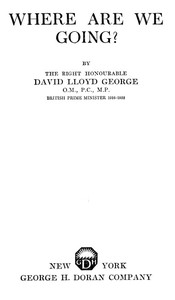
For Where Are We Going? — Themes and Context, the stored edition analysis reports 72,488 words, 5 hr 16 min estimated reading time, and 7 detected text sections.
The text analysis averages about 20.0 words per sentence, while the detected sections provide another way to judge how the source is divided.
Project Gutenberg metadata also associates the work with “World politics,” connecting these edition facts with the source record’s subject description.
Explore this collection
These alternatives are selected using recorded categories and estimated reading time.
About 324 minutes
World Events
74,472 recorded words. 8 minutes difference from this book's estimate.
View Gutenberg source #10809About 306 minutes
World Events
70,203 recorded words. 10 minutes difference from this book's estimate.
View Gutenberg source #53651About 304 minutes
World Events
69,722 recorded words. 12 minutes difference from this book's estimate.
View Gutenberg source #11571Search stored excerpts and compare books → Choose by your preferences →
Choices use stored catalog measurements. Estimates vary with reading speed. A shared category is a catalog label, not a claim that two books have the same argument or literary quality.
Search reads excerpt text stored with this catalog and links to its associated Gutenberg record. The connection is stored in the site database; this tool does not recheck that every excerpt is word-for-word identical to that external record. Excerpt search does not cover every chapter and does not verify historical publication dates.
Catalog snapshot checked: 2026-09-25. Coverage: 91 public books, 91 available source excerpts.
Read the complete public-domain text at its original source.
Read on Project GutenbergDavid Lloyd George, British Prime Minister from 1916 to 1922, published Where Are We Going? in 1923 as a collection of essays written over the preceding ten months. The book opens with a stark contrast: the author recalls the optimism of the Genoa Conference in May 1922, where a speaker described the atmosphere as “blue skies and a serene firmament,” only to note that by the time of writing, such words “would be greeted with scoffing laughter.” This shift from hope to gloom sets the tone for a work that examines the unraveling of post-war peace.
The excerpts reveal a former prime minister deeply engaged in the reparations dispute between Germany and the Allies. Lloyd George draws on his own experience settling industrial disputes to argue that negotiation, not ultimatums, is the path to resolution. He criticizes the rejection of Germany’s offer to accept an international expert commission—a proposal he traces to U.S. Secretary of State Hughes’s New Haven speech—and expresses bafflement at why Allied governments ignored this opportunity.
Lloyd George structures his argument around a clear before-and-after timeline. He describes the years immediately after the Great War as showing “a distinct improvement over its predecessor,” with healing and a return to reason. The Cannes discussions of January 1922, he notes, lacked the hostility that poisoned the Spa discussions in 1920. But the present year, 1923, has been “one of growing gloom and menace,” with the international temper “distinctly worse all round.”
This pattern is not merely asserted; it is anchored in specific events. The author points to a peace “patched up with the Turkish Empire” that no one believes can endure, and warns that other patched-up treaties will leave European peace “in a more precarious plight than ever.” He identifies a recurring cause: “A peace wrung by triumphant force out of helplessness is never a good peace.” This observation leads him to view with apprehension the settlement being imposed on Germany in the Ruhr and on Greece in the Adriatic.
A central thread in the excerpts is Lloyd George’s critique of the Allies’ refusal to negotiate with Germany. He draws a pointed analogy from his own career: “I have taken part in the settlement of probably more industrial differences than most politicians. In every case I have started with an impasse.” The first meeting always revealed “an apparently unbridgeable chasm,” but perseverance and honest endeavor usually ended in agreement. “Goodwill can bridge any abyss,” he writes.
He applies this logic to the German reparations offer. Even if the initial figure was inadequate, he argues, the German note included an alternative: acceptance of the Hughes proposal for an international expert commission. Lloyd George calls this “the supreme opportunity for placing the vexed question … on a pathway which must inevitably lead to a real settlement.” He is “perplexed by the rude indifference” with which the Allies treated this proposal, and suggests that those who wish to “exploit reparations for ulterior purposes” would want to keep America out.
Lloyd George places particular weight on U.S. Secretary of State Hughes’s New Haven speech, which proposed an international expert commission to determine Germany’s capacity to pay. He recalls that upon first reading it, he “cabled from Spain to the British and American papers” urging immediate consideration. The proposal, he insists, offered a way out of the reparations entanglement that was “fretting Europe almost into nervous paralysis.”
Yet the Allied governments, including Britain, Italy, and Belgium, neglected to bring it before the conference. Lloyd George admits he is “baffled to explain” this failure, though he can suggest explanations that would be “a grave reflection on the way in which the proceedings of that conference were handled.” The implication is clear: diplomatic opportunities were squandered, and the consequences are being felt in the worsening crisis of 1923.
Readers should approach Where Are We Going? as a primary document of post-war disillusionment, written by a key architect of the peace. Lloyd George’s insider perspective gives weight to his warnings, but his arguments are also shaped by his own political position and the limits of his knowledge at the time. The book is best read alongside other accounts of the reparations debate, noting where his predictions align with or diverge from subsequent events.
I kept thinking about Lloyd George's unease, how peace felt like a held breath after the war. It reminded me of another quiet book, one I found later, about the careful, patient work of aiming. There’s a strange tenderness in its precision. Sniping in France: With notes on the scientific training of scouts, observers, and snipers — A Reader’s Guide stays with you the same way—less about combat, more about the long stillness before a choice.
Capture what you thought, learned, and would like to remember.