About 275 minutes
Sniping in France: With notes on the scientific training of scouts, observers, and snipers — A Reader’s Guide
World Events
63,067 recorded words. 4 minutes difference from this book's estimate.
View Gutenberg source #68964
The source record for Ravished Armenia The Story of Aurora Mardiganian, the Christian Girl Who Lived Through the Great Massacres — Context and Discussion measures this digital text at 62,311 words, 4 hr 31 min estimated reading time, and 6 detected text sections.
The text analysis averages about 18.1 words per sentence, while the detected sections provide another way to judge how the source is divided.
Project Gutenberg metadata also associates the work with “World War, 1914-1918 -- Personal narratives,” connecting these edition facts with the source record’s subject description.
Explore this collection
These alternatives are selected using recorded categories and estimated reading time.
About 275 minutes
World Events
63,067 recorded words. 4 minutes difference from this book's estimate.
View Gutenberg source #68964About 286 minutes
World Events
65,670 recorded words. 15 minutes difference from this book's estimate.
View Gutenberg source #70223About 301 minutes
World Events
69,041 recorded words. 30 minutes difference from this book's estimate.
View Gutenberg source #11947Search stored excerpts and compare books → Choose by your preferences →
Choices use stored catalog measurements. Estimates vary with reading speed. A shared category is a catalog label, not a claim that two books have the same argument or literary quality.
Search reads excerpt text stored with this catalog and links to its associated Gutenberg record. The connection is stored in the site database; this tool does not recheck that every excerpt is word-for-word identical to that external record. Excerpt search does not cover every chapter and does not verify historical publication dates.
Catalog snapshot checked: 2026-09-25. Coverage: 91 public books, 91 available source excerpts.
Read the complete public-domain text at its original source.
Read on Project GutenbergThe narrative begins not with the first atrocity but with a dedication: Aurora Mardiganian addresses American mothers and fathers, framing her story as a message of faith and survival. This paratext immediately establishes the book's dual purpose—personal testimony and plea for aid. The opening chapter, “When the Pasha Came to My House,” plunges into domestic life disrupted by Ottoman officials, a pattern that recurs throughout the excerpts: the intrusion of armed men into private spaces.
The voice is that of a young girl, often noting her age (“little over fourteen”) and physical exhaustion. The prose, interpreted by H.L. Gates, is direct and sensory—bare feet on cobblestones, the weight of hunger. The American flag appears as a recurring motif, first as a visual relief in Malatia, then as a contested symbol of protection when missionary Miss McLaine defies Turkish soldiers.
The book’s dedication is not a mere courtesy; it sets the emotional and rhetorical stakes. Mardiganian writes to “each mother and father, in this beautiful land of the United States,” linking her parents’ deaths to their Christian faith. She saw her mother’s body “flung onto the desert” and her father die “in pain” for teaching her to trust in God. This opening positions the reader as a surrogate parent, invited to receive a “message from those of my people who are left.”
The dedication also reveals the book’s origin: written in December 1918, after the war, and tied to a motion picture spectacle produced for the American Committee for Armenian and Syrian Relief. The text is thus both memoir and fundraising tool, a context that shapes its urgency and selective detail.
In the Malatia excerpt, the flag is not just a symbol but a plot device. Mardiganian, lost and exhausted, hides near a house flying the American flag. She recalls: “The American flag is very beautiful to the eyes of all Armenians! For many years it has been to my people the promise of peace and happiness.” This moment of relief is immediately tested when Turkish citizens spot her and demand she be handed over.
The flag’s power is embodied by Miss McLaine, an American missionary who refuses to surrender the girl. She tells the Turks, “You dare not harm an American!” The flag, and the national identity it represents, becomes a fragile shield. The scene underscores how international presence—missionaries, consuls—could momentarily interrupt the machinery of deportation, but also how limited that protection was.
Mardiganian repeatedly emphasizes her physical state: “My bare feet were tired from walking all night on cobblestones and pavements. I felt very tired—not as if I really were but little over fourteen.” These details ground the horror in a child’s body. The narrative does not dwell on abstract numbers but on the sensation of being hunted while hungry and footsore.
The excerpts show a pattern of hiding and being discovered. In Malatia, she hides in an areaway; earlier, she is carried into Turkish shops. The body is always at risk—of being “carried away,” “outraged,” or lost. The text’s power lies in this relentless physicality, which makes the reader feel the weight of each step and the terror of each knock on a door.
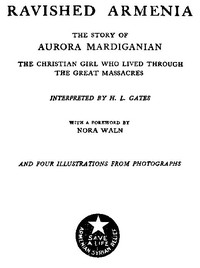
The title page credits H.L. Gates as “Interpreter,” not author or translator. The foreword is by Nora Waln, who also wrote the scenario for the film. This layered authorship raises questions about voice. The excerpts read as first-person, but the prose is polished, with dramatic pacing and dialogue that feels shaped for a Western audience.
For instance, Miss McLaine’s speeches are rendered in fluent, defiant English: “Your Kaimakam’s orders have nothing to do with me. I shall protect the girl.” Whether Mardiganian spoke these exact words is unknowable. The reader must accept that the narrative is mediated—interpreted for readability and impact. The book is best approached as a collaborative testimony, where the survivor’s experience is filtered through an American interpreter’s hand.
Reading Ravished Armenia requires attention to its dual nature: as a personal story and as a document shaped for advocacy. The excerpts show a young narrator who survives by luck, foreign intervention, and her own resourcefulness. The American flag, the missionary’s door, and the dedication to parents all point to the book’s intended audience—Americans who could offer relief. The text is not a neutral record but a plea, and its power lies in that urgency.
That book held Aurora’s voice so close that I still feel its weight. The way she clung to the American flag as a promise of safety made me think of our own blind trust in distant things. I found myself reaching for America and the World War — Reading Companion afterward, wondering how that same hope looked from the other shore, quiet and trembling.
Use these questions to collect your thoughts before moving on.