About 463 minutes
The Story of a Common Soldier of Army Life in the Civil War, 1861-1865 — Inside the Classic
Modern Nations
106,399 recorded words. 8 minutes difference from this book's estimate.
View Gutenberg source #26561
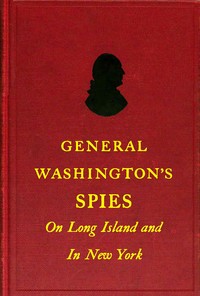
The catalog record for General Washington's spies on Long Island and in New York — Themes and Context provides practical reading context through 104,486 words, 7 hr 35 min estimated reading time, and 30 detected text sections.
The text analysis averages about 20.3 words per sentence, while the detected sections provide another way to judge how the source is divided.
Project Gutenberg metadata also associates the work with “New York (N.Y.) -- History -- Revolution, 1775-1783,” connecting these edition facts with the source record’s subject description.
Explore this collection
These alternatives are selected using recorded categories and estimated reading time.
About 463 minutes
Modern Nations
106,399 recorded words. 8 minutes difference from this book's estimate.
View Gutenberg source #26561About 473 minutes
Modern Nations
108,691 recorded words. 18 minutes difference from this book's estimate.
View Gutenberg source #11454About 384 minutes
Modern Nations
88,304 recorded words. 71 minutes difference from this book's estimate.
View Gutenberg source #72166Search stored excerpts and compare books → Choose by your preferences →
Choices use stored catalog measurements. Estimates vary with reading speed. A shared category is a catalog label, not a claim that two books have the same argument or literary quality.
Search reads excerpt text stored with this catalog and links to its associated Gutenberg record. The connection is stored in the site database; this tool does not recheck that every excerpt is word-for-word identical to that external record. Excerpt search does not cover every chapter and does not verify historical publication dates.
Catalog snapshot checked: 2026-09-25. Coverage: 91 public books, 91 available source excerpts.
Read the complete public-domain text at its original source.
Read on Project GutenbergMorton Pennypacker's General Washington's Spies on Long Island and in New York, published in 1939 by the Long Island Historical Society, is a focused documentary history of Revolutionary War espionage in the New York theater. Rather than offering a broad narrative of the conflict, Pennypacker assembles and analyzes primary sources—letters, depositions, and official reports—to reconstruct the activities of Washington's intelligence network. The book's subtitle might suggest a comprehensive overview, but the excerpts reveal a work deeply rooted in specific episodes, such as the capture of Major John André, recounted through the testimonies of his captors John Paulding and David Williams. Pennypacker lets these witnesses speak at length, preserving the raw, colloquial voice of the period.
The excerpts devote considerable space to verbatim accounts from the men who stopped André. Paulding's deposition, quoted at length, describes the encounter in a conversational, almost rambling style: “I told him to pull off his clothes, which he did. We searched his clothes, but could find nothing; and I told him to pull off his boots.” Pennypacker does not smooth this into polished prose; he lets the speakers' own words carry the drama. Williams's corroborating statement is noted but not reprinted, suggesting the author's editorial judgment about redundancy. This method privileges the texture of firsthand testimony over authorial synthesis, giving readers direct access to the language and mindset of ordinary soldiers.
Pennypacker's account of André's capture highlights the practical details of spycraft: the use of passes, the hiding of papers in stockings, and the negotiation of bribes. When Paulding finds the documents, he declares “This is a spy,” and the captors immediately test André's willingness to buy his freedom. The dialogue records specific sums—a hundred guineas, ten thousand guineas—and offers of dry goods. These details ground the episode in the material realities of the time. The author also notes a later controversy: Major Tallmadge opposed increasing the captors' reward in 1817, implying that Pennypacker is attentive to the long aftermath of these events, not just the moment of capture.
The book's front matter reveals its origins as a society publication, with a full list of officers and directors of the Long Island Historical Society. This institutional framing suggests a work aimed at a regional historical audience rather than a popular market. The transcriber's notes indicate the text includes both footnotes (numbered 1–72) and endnotes (101–142), a dual system that may reflect the author's effort to separate textual commentary from supplementary documentation. The presence of illustrations, including a painting of Washington's council of war, points to a visually supported argument. Readers should expect a scholarly apparatus that rewards careful attention to the notes.
Pennypacker's book is best approached as a source collection with connective tissue, not a seamless narrative. Readers interested in the texture of Revolutionary intelligence work will find value in the extended primary quotations, but those seeking a synthetic overview may need to piece together the broader network from the episodic evidence. The author's reliance on depositions and official records means the book reflects the perspectives of the men who wrote them—soldiers, officers, and spies—rather than a modern analytical framework. Patience with the period language and the documentary format will reward those who want to hear the voices of the past directly.
I’ve spent many afternoons with Morton Pennypacker’s spies — their coded letters, their plotted routes across Long Island. What stays with me is how much depended on patience and weather. That same hush, the same waiting on tides and winds, lives in The Influence of Sea Power upon the French Revolution and Empire 1793-1812, vol 2 — Reading Companion, where fleets move less by glory than by quiet calculation. Two old friends, both knowing the sea’s slow arithmetic.
Capture what you thought, learned, and would like to remember.