About 592 minutes
The Soul of the War — Reading Companion
Modern Nations
136,109 recorded words. 58 minutes difference from this book's estimate.
View Gutenberg source #11682
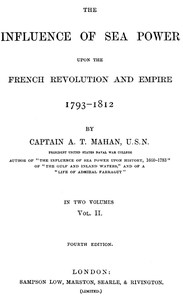
The catalog record for The Influence of Sea Power upon the French Revolution and Empire 1793-1812, vol 2 — Reading Companion provides practical reading context through 149,297 words, 10 hr 50 min estimated reading time, and 27 detected text sections.
The text analysis averages about 27.6 words per sentence, while the detected sections provide another way to judge how the source is divided.
Project Gutenberg metadata also associates the work with “France -- History -- Revolution, 1789-1799,” connecting these edition facts with the source record’s subject description.
Explore this collection
These alternatives are selected using recorded categories and estimated reading time.
About 592 minutes
Modern Nations
136,109 recorded words. 58 minutes difference from this book's estimate.
View Gutenberg source #11682About 587 minutes
Modern Nations
135,009 recorded words. 63 minutes difference from this book's estimate.
View Gutenberg source #12068About 473 minutes
Modern Nations
108,691 recorded words. 177 minutes difference from this book's estimate.
View Gutenberg source #11454Search stored excerpts and compare books → Choose by your preferences →
Choices use stored catalog measurements. Estimates vary with reading speed. A shared category is a catalog label, not a claim that two books have the same argument or literary quality.
Search reads excerpt text stored with this catalog and links to its associated Gutenberg record. The connection is stored in the site database; this tool does not recheck that every excerpt is word-for-word identical to that external record. Excerpt search does not cover every chapter and does not verify historical publication dates.
Catalog snapshot checked: 2026-09-25. Coverage: 91 public books, 91 available source excerpts.
Read the complete public-domain text at its original source.
Read on Project GutenbergMahan opens this volume with a dense examination of the legal and strategic clash over neutral shipping, framing the dispute as a deadlock where opposing arguments "resemble rather opposite and equal weights in a balance." He quotes Lord Howick's 1807 definition of neutrality as "observing a strict and honest impartiality," contrasting it with the American position that municipal regulations cannot limit neutral rights in war. The authorial voice is analytical, weighing each side's premises without endorsing either, and the prose is marked by legal precision and military context.
Mahan devotes sustained attention to the Rule of 1756, which forbade neutrals from trading in wartime with belligerent colonies that were closed to them in peace. He notes that the British order of November 6, 1793, led to the seizure of "some hundreds of American ships" in West Indian ports. The author points out two objections: the rule was applied without warning, and the prewar trade between the French West Indies and the United States had been permitted in vessels of sixty tons and upwards. Mahan's treatment is not merely descriptive; he dissects the logic behind each nation's stance, showing how the British relaxed their own peace regulations for advantage while denying the same flexibility to neutrals. The reader sees a historian who values clarity of argument and who uses specific tonnage figures and dates to ground his analysis.
Mahan frequently incorporates direct quotations from diplomatic letters and official statements, using them as primary evidence for the irreconcilable positions of the belligerents. For instance, he cites the neutral reply: "Because the parent country monopolizes in peace the whole commerce of its colonies, does it follow that in war it should have no right to regulate it at all?" This technique gives voice to historical actors and reveals the rhetorical strategies of the time. Mahan's own commentary then steps back to note that such arguments "do not fairly meet each other" and that they lead to a deadlock resolvable only by force. The authorial choice to let the documents speak, then to interpret their implications, creates a layered narrative that combines legal reasoning with strategic realism.
Beyond legal doctrine, Mahan connects maritime policy to broader military outcomes. He traces how British seizures of American ships nearly provoked a rupture with the United States, and how the revocation of the November order in January 1794 eased tensions but did not resolve the underlying principle. The author also links these disputes to the formation of the Armed Neutrality of 1800, where Russia, Prussia, Sweden, and Denmark aligned against British maritime claims. Mahan's prose here is brisk and focused on cause and effect: he shows how a seemingly narrow legal question—the right to regulate colonial trade—escalated into a coalition that threatened British naval dominance. The reader gains an appreciation for how Mahan treats diplomacy as an extension of naval strategy.
Throughout the excerpt, Mahan juxtaposes British and American legal arguments without resolving them, a deliberate authorial choice that underscores the complexity of international law. He quotes Lord Howick's assertion that neutrality requires "so far restraining its trade to the accustomed course which it held in time of peace, as not to render assistance to one belligerent." Against this, he sets the American view that municipal regulations cannot bind neutrals. Mahan refrains from declaring a winner, instead observing that "an agreement among any number of the subjects of the interested nation proves nothing as to the right of the question." This evenhandedness is characteristic of his method: he presents evidence, identifies logical gaps, and leaves the reader to weigh the competing claims. The effect is a scholarly tone that prioritizes analysis over advocacy.
Readers approaching this volume should expect a work that blends naval history with legal and diplomatic analysis. Mahan's prose demands careful attention to his use of quotations and his habit of stepping back to assess the strategic implications of policy decisions. The excerpts suggest a book that rewards those interested in how maritime law shaped the great-power conflicts of the Revolutionary and Napoleonic era.
I picked up Mahan’s second volume the other day, and that old tug about how choices on the water ripple into everything else came back to me. It sat with me, that quiet sense of nations tangled in rules they couldn’t bend. It reminded me of Antwerp to Gallipoli: A Year of the War on Many Fronts—and Behind Them — Edition Insights, actually, in how war’s patience shows itself there, too.
Create a short personal record of your experience with this book.