About 360 minutes
Antwerp to Gallipoli: A Year of the War on Many Fronts—and Behind Them — Edition Insights
Modern Nations
82,736 recorded words. 24 minutes difference from this book's estimate.
View Gutenberg source #11008
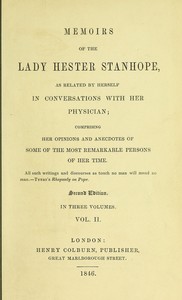
The source record for Memoirs of the Lady Hester Stanhope, as related by herself in conversations with her physician, vol. 2 (of 3) — Story, Setting & Ideas measures this digital text at 88,304 words, 6 hr 24 min estimated reading time, and 19 detected text sections.
The text analysis averages about 24.8 words per sentence, while the detected sections provide another way to judge how the source is divided.
Project Gutenberg metadata also associates the work with “Middle East -- Description and travel,” connecting these edition facts with the source record’s subject description.
Explore this collection
These alternatives are selected using recorded categories and estimated reading time.
About 360 minutes
Modern Nations
82,736 recorded words. 24 minutes difference from this book's estimate.
View Gutenberg source #11008About 349 minutes
Modern Nations
80,192 recorded words. 35 minutes difference from this book's estimate.
View Gutenberg source #39954About 343 minutes
Modern Nations
78,833 recorded words. 41 minutes difference from this book's estimate.
View Gutenberg source #49500Search stored excerpts and compare books → Choose by your preferences →
Choices use stored catalog measurements. Estimates vary with reading speed. A shared category is a catalog label, not a claim that two books have the same argument or literary quality.
Search reads excerpt text stored with this catalog and links to its associated Gutenberg record. The connection is stored in the site database; this tool does not recheck that every excerpt is word-for-word identical to that external record. Excerpt search does not cover every chapter and does not verify historical publication dates.
Catalog snapshot checked: 2026-09-25. Coverage: 91 public books, 91 available source excerpts.
Read the complete public-domain text at its original source.
Read on Project GutenbergLady Hester Stanhope’s voice dominates this second volume of her memoirs, recorded by her physician Charles Lewis Meryon. She speaks with a directness that cuts through the formalities of early nineteenth-century biography, offering blunt assessments of figures like Mr. Pitt and the Duke of Wellington. Her narrative shifts between London drawing-rooms and Syrian villages, but the tone remains consistently opinionated and self-aware. Meryon’s editorial presence is minimal, allowing her words to carry the weight of the account. The result is a portrait that feels less like a polished memoir and more like an extended, unfiltered conversation.
Lady Hester’s speech is marked by a refusal to soften her judgments. She describes a general who “talked away largely and foolishly” and recounts her own expedient to secretly give him money—a Tartar pretending to deliver a gift from a former soldier. Her phrasing is precise and unsparing: she notes how the general “seemed to forget how much it was his duty not to put her ladyship to more trouble.” The memoir captures her habit of shifting between indignation and wry observation, often within the same sentence. Meryon records her words with little interference, preserving the rhythms of her speech. This directness extends to her views on politics, where she dismisses figures with a few sharp phrases, as when she remarks on Mr. Pitt’s “life wasted in the service of his country.” The effect is a narrative that feels immediate and personal, as if the reader is overhearing a private conversation.
The excerpts show Lady Hester’s eye for concrete detail. She describes a tomb in her garden “ornamented with flowering shrubs, and entirely shaded by a beautiful arbour,” and notes the precise contents of the general’s luggage: “five trunks full of clothes and other things, with two watches bought with the money I had given him, and with a good bag full of piasters.” These details serve not merely as decoration but as evidence of her meticulous attention to the material world around her. She also records the practicalities of her household, such as sending “fresh meat of my own killing, flour for his bread when it was wanting, sugar, tea, coffee—and everything, I may say, except milk and vegetables.” Such passages ground her opinions in the tangible realities of her Syrian life, contrasting with the abstract political anecdotes of earlier chapters.
Throughout the volume, Lady Hester presents herself as a figure caught between her own will and the demands of others. She describes providing for a difficult general who “seemed to forget how much it was his duty not to put her ladyship to more trouble and expense than he could help.” Her solution—a staged gift from a fictional pilgrim—reveals both her resourcefulness and her awareness of social niceties. The general’s ungrateful response, claiming he “would sooner live with the devil than with such a woman as I was,” underscores the friction between her generosity and her expectations. This tension recurs in her accounts of British politics, where she portrays herself as a loyal but undervalued confidante. The memoir thus offers a portrait of a woman navigating power structures that both rely on and resist her influence.
Charles Lewis Meryon frames the volume as a record of Lady Hester’s “opinions and anecdotes,” but his role is not entirely passive. He organizes her speech into chapters with descriptive headings, such as “Conscription in Syria” and “Lady Hester’s despondency,” shaping the reader’s expectations. The excerpts show him occasionally inserting his own observations, as when he notes that the general “seemed to have no greater pleasure than watching our daughter whilst she watered her flowers.” This first-person plural (“our daughter”) subtly asserts his presence as a participant, not merely a scribe. Readers should consider how Meryon’s selection and arrangement may color the portrait. The memoir is a collaboration, and its authority rests on the interplay between Stanhope’s forceful voice and her physician’s editorial choices.
This volume rewards attention to the small gestures and offhand remarks that reveal Lady Hester’s character. Her descriptions of daily life in Syria—the garden, the servants, the negotiations with local officials—are as telling as her judgments of British politicians. Readers interested in the texture of her experience will find more in the concrete details than in the broader historical claims. Approach the text as a layered document, where the editor’s presence is as significant as the narrator’s voice.
Reading Lady Hester’s blunt, uncompromising opinions, I remembered my grandmother’s worn copy of Three Wisconsin Cushings A sketch of the lives of Howard B., Alonzo H. and William B. Cushing, children of a pioneer family of Waukesha County — Story, Setting & Ideas. Both books feel less like history and more like overheard voices—people insisting on their own version of events, stubborn and alive. That same intimacy once startled me in a diary of a frontier doctor.
Capture what you thought, learned, and would like to remember.