About 1,016 minutes
The loyalists of America and their times — Context and Discussion
Modern Nations
233,522 recorded words. 508 minutes difference from this book's estimate.
View Gutenberg source #21012
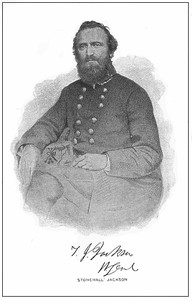
Stonewall Jackson and the American Civil War — A Reader’s Guide can be approached with a clearer sense of reading commitment from its source measurements: 350,380 words, 25 hr 24 min estimated reading time, and 49 detected text sections.
The text analysis averages about 23.1 words per sentence, while the detected sections provide another way to judge how the source is divided.
Project Gutenberg metadata also associates the work with “United States -- History -- Civil War, 1861-1865 -- Campaigns,” connecting these edition facts with the source record’s subject description.
Explore this collection
These alternatives are selected using recorded categories and estimated reading time.
About 1,016 minutes
Modern Nations
233,522 recorded words. 508 minutes difference from this book's estimate.
View Gutenberg source #21012About 650 minutes
Modern Nations
149,297 recorded words. 874 minutes difference from this book's estimate.
View Gutenberg source #52589About 592 minutes
Modern Nations
136,109 recorded words. 932 minutes difference from this book's estimate.
View Gutenberg source #11682Search stored excerpts and compare books → Choose by your preferences →
Choices use stored catalog measurements. Estimates vary with reading speed. A shared category is a catalog label, not a claim that two books have the same argument or literary quality.
Search reads excerpt text stored with this catalog and links to its associated Gutenberg record. The connection is stored in the site database; this tool does not recheck that every excerpt is word-for-word identical to that external record. Excerpt search does not cover every chapter and does not verify historical publication dates.
Catalog snapshot checked: 2026-09-25. Coverage: 91 public books, 91 available source excerpts.
Read the complete public-domain text at its original source.
Read on Project GutenbergHenderson's study of Stonewall Jackson is built around a sequence of campaign chapters—from West Point through Chancellorsville—each anchored to specific terrain and troop movements. The author repeatedly returns to the Valley Campaign as a structural pivot, using it to illustrate Jackson's characteristic speed and concealment. Casualty tables and order-of-battle summaries appear regularly, grounding the narrative in quantitative evidence.
The work's movement between scenes is deliberate: Henderson shifts from broad strategic overviews to close tactical moments, such as Jackson nearly being captured while riding forward in darkness. This alternation between scale and proximity gives the biography a rhythm that mirrors Jackson's own operational style.
The book's forty-nine text sections are organized as a chronological march through Jackson's military career, from West Point to his death. Each battle chapter follows a consistent pattern: a situation report, a description of terrain, the engagement itself, and a casualty table. For instance, the Seven Days battles are split across two chapters (Gaines' Mill and Frayser's Farm/Malvern Hill), each ending with detailed loss figures by division and regiment. This structure allows Henderson to treat each engagement as a discrete analytical unit while maintaining the larger campaign arc.
The inclusion of maps—such as those for Bull Run, Kernstown, and Chancellorsville—reinforces the spatial logic. Readers encounter the same place names (Winchester, Harper's Ferry, Fredericksburg) across multiple chapters, creating a sense of recurring geography. Henderson rarely lingers on non-military matters; even the chapter on winter quarters is titled "Winter Quarters" and focuses on army reorganization rather than personal reflection.
Henderson repeatedly emphasizes Jackson's use of rapid marches and hidden approaches. The phrase "set spurs to his horse" appears in the excerpt describing Jackson's near-capture, a small but telling detail that recurs in other accounts of his personal mobility. The author also highlights the Confederate cavalry's superior knowledge of the country, contrasting it with Federal forces that struggled to track Jackson's movements.
The landscape itself becomes a character: the Shenandoah Valley, the Chickahominy swamps, the slopes of Malvern Hill. Henderson notes how Jackson used ridges and river lines to screen his columns, and how the Federal commanders repeatedly misjudged his position. This emphasis on concealment and surprise gives the narrative a cat-and-mouse quality, with Jackson always one step ahead.
Henderson uses casualty tables not merely as data but as structural punctuation. After describing the fighting at Gaines' Mill, he inserts a table showing losses by division: Jackson's own division lost 600, Ewell 650, Whiting 1,020, D.H. Hill 1,430. These numbers serve as a kind of rhythm, marking the intensity of each engagement. The author also compares Confederate and Federal losses, noting that 8,000 Confederates were killed or wounded at Gaines' Mill versus 2,830 Federals captured or missing.
This quantitative approach extends to regimental losses: the 4th Texas lost 20 officers and 230 men; the 20th North Carolina lost 70 killed and 200 wounded. By drilling down to the regimental level, Henderson makes the scale of destruction tangible. The tables also reveal his method: he draws on official reports (O.R., vol. xi) and cross-references them with Confederate historians, creating a layered evidentiary base.
Henderson shifts fluidly between the general's-eye view and the soldier's experience. In the excerpt, he moves from a discussion of McClellan's estimate of Confederate numbers to a note on cavalry proportions, then to Stuart's report, and finally to a detailed breakdown of which regiments charged which hill. This telescoping effect is characteristic: a paragraph might begin with corps-level dispositions and end with a single regiment's casualties.
The author also alternates between narrative and analysis. After describing Jackson's capture of Federal pickets, he immediately inserts a footnote referencing official reports. This technique keeps the story moving while grounding it in documentation. The result is a work that feels both cinematic and scholarly, though the excerpts offer no evidence of how Henderson handles Jackson's personal life or the broader political context.
Henderson's biography rewards readers who attend to its maps and tables as closely as its prose. The casualty figures and order-of-battle details are not appendages but integral to the argument about Jackson's effectiveness. Because the excerpts focus almost entirely on military operations, readers should expect little about Jackson's pre-war life or postwar legacy. The work is best approached as a campaign study, with the understanding that its structure—battle by battle, with recurring attention to terrain and movement—is itself a form of analysis.
Reading Henderson’s maps of the Valley, I remembered tracing my grandfather’s trembling finger over a similar page, his quiet stories of moving troops through those same gaps. That weight of ground felt familiar when I later lingered over the ironclads’ charts in The Monitor and the Merrimac — Edition Insights—two books that made me see a battlefield as a place people carry home.
Build a private reading journal entry for this title.