
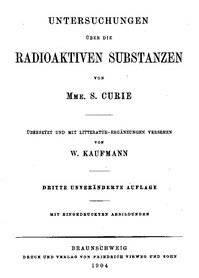
Untersuchungen über die radioaktiven Substanzen von Marie Curie, übersetzt und…
Read "Untersuchungen über die radioaktiven Substanzen von Marie Curie, übersetzt und…" Online
This book is available in the public domain. Start reading the digital edition below.
START READING FULL BOOKBook Preview
A short preview of the book’s content is shown below to give you an idea of its style and themes.
Let's be clear: this isn't a novel. 'Investigations on Radioactive Substances' is Marie Curie's doctoral thesis, her official report to the world. But don't let that fool you into thinking it's boring. It's a firsthand account of one of the greatest scientific discoveries of all time.
The Story
The 'plot' is the hunt. It starts with a curious observation: certain rocks, like uranium ore, could make the air around them conduct electricity. No one knew why. Marie Curie decided to find out. The book walks us through her methodical search. She tested every element she could find, looking for this strange 'radioactivity.' She found it in thorium, then made her big leap: the ore itself was more radioactive than pure uranium. This meant there had to be something new in there, something incredibly powerful. The rest of the story is her and Pierre's brutal, physical work to isolate not one, but two new elements from tons of pitchblende: polonium and radium. The book documents every painstaking step, from chemical separations to measuring faint glows in the dark.
Why You Should Read It
You should read it to hear Marie Curie's voice. There's no boastful drama, just clear, logical reasoning. You see her brilliant mind at work, connecting dots. You also feel the immense effort. This isn't magic; it's hard work documented in real time. It demystifies genius. Reading her careful notes about handling 'radioactive residues' is also strangely poignant, knowing what we know now about the dangers she was unknowingly facing. It adds a layer of quiet bravery to the text.
Final Verdict
This book is perfect for anyone tired of science being presented as a list of facts. It's for the curious person who wants to see the messy, glorious process. It’s not a light read—you have to want to engage with the science—but it is a profoundly rewarding one. Think of it as the ultimate primary source. You're not reading about history; you're reading the history itself, written by the woman who made it.
This content is free to share and distribute. Share knowledge freely with the world.
Ashley Rodriguez
1 year agoThis work demonstrates a clear mastery of contemporary theories.
David Miller
2 years agoThe layout is perfect for tablet and e-reader devices.
Ashley Miller
1 year agoI was particularly interested in the case studies mentioned here, the visual layout and supporting data make the reading experience very smooth. Definitely a five-star contribution to the field.
Nancy Gonzalez
1 year agoIt effectively synthesizes complex ideas into a coherent whole.
Margaret Rodriguez
11 months agoHaving followed this topic for years, I can say that the historical context mentioned in the early chapters is quite enlightening. I'll be recommending this to my students and colleagues alike.