About 126 minutes
The Twenty-fifth Regiment Connecticut Volunteers in the War of the Rebellion — Edition Insights
Modern Nations
28,852 recorded words. 10 minutes difference from this book's estimate.
View Gutenberg source #24307
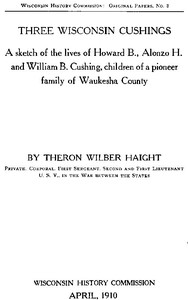
For Three Wisconsin Cushings A sketch of the lives of Howard B., Alonzo H. and William B. Cushing, children of a pioneer family of Waukesha County — Story, Setting & Ideas, the stored edition analysis reports 26,601 words, 1 hr 56 min estimated reading time, and 24 detected text sections.
The text analysis averages about 22.1 words per sentence, while the detected sections provide another way to judge how the source is divided.
Project Gutenberg metadata also associates the work with “United States -- History -- Civil War, 1861-1865 -- Biography,” connecting these edition facts with the source record’s subject description.
Explore this collection
These alternatives are selected using recorded categories and estimated reading time.
About 126 minutes
Modern Nations
28,852 recorded words. 10 minutes difference from this book's estimate.
View Gutenberg source #24307About 133 minutes
Modern Nations
30,404 recorded words. 17 minutes difference from this book's estimate.
View Gutenberg source #14086About 133 minutes
Modern Nations
30,482 recorded words. 17 minutes difference from this book's estimate.
View Gutenberg source #64992Search stored excerpts and compare books → Choose by your preferences →
Choices use stored catalog measurements. Estimates vary with reading speed. A shared category is a catalog label, not a claim that two books have the same argument or literary quality.
Search reads excerpt text stored with this catalog and links to its associated Gutenberg record. The connection is stored in the site database; this tool does not recheck that every excerpt is word-for-word identical to that external record. Excerpt search does not cover every chapter and does not verify historical publication dates.
Catalog snapshot checked: 2026-09-25. Coverage: 91 public books, 91 available source excerpts.
Read the complete public-domain text at its original source.
Read on Project GutenbergHaight opens with a New England exodus, then traces the Cushing family from western New York to Milwaukee and the Nemahbins, establishing a pattern of westward movement before the war. The narrative quickly narrows to the three brothers, each entering different branches of service. The author, a Union veteran himself, draws on family letters and official reports, but the excerpts reveal an uneven focus: William's naval adventures receive the most vivid treatment, while Alonzo and Howard are sketched more briefly. Readers should note the erratum correcting swapped portraits—a sign of hasty production that may affect visual identification of the brothers.
William B. Cushing emerges as the most fully drawn figure. His letter to his mother, written after the siege of Suffolk, shows a young officer blending bravado and affection: he calls himself a "hair-brained, scapegrace" and boasts of being "the only lieutenant in the regular navy who has a [separate] command." Haight includes nearly the full letter, letting William speak in his own voice. The excerpts also detail his command of the gunboat Ellis, his destruction of the schooner Adelaide and salt works, and the eventual loss of his vessel after running aground. The admiral's response—"We don't care for the loss of a vessel when fought so gallantly as that"—underscores the value placed on aggressive action over material preservation.
Alonzo H. Cushing appears primarily through a single facsimile letter and the erratum that confuses his portrait with Howard's. The chapter "After Gettysburg" suggests his death occurred during that battle, but the excerpts provide no direct account of his actions. Haight's treatment is notably sparse: Alonzo's service is compressed into a few pages, and the reader must infer his role from the chapter title and the index. This imbalance may reflect the availability of sources—William's letters are quoted at length, while Alonzo's story seems to rely on official records. The erratum itself hints at editorial challenges that may have shaped the final text.
Howard B. Cushing's section is titled "Howard Cushing with the Artillery" and later "Transferred to the Cavalry," but the excerpts offer only a facsimile of his letter and the chapter heading. The index lists his death as a "young cavalryman," yet no details of his service or demise appear in the provided text. Haight's structure suggests a parallel arc for each brother—early life, war service, death—but the execution is uneven. Readers will need to consult the full book to understand Howard's specific actions, as the excerpts leave him largely a name. The brevity may reflect the author's decision to prioritize William's more dramatic narrative.
Haight, writing as a fellow veteran, adopts a straightforward, reportorial style. He frequently inserts letters and official reports, letting documents carry the story. The chapter "William's Letter to His Mother" is presented "nearly in full," and the admiral's endorsement is quoted verbatim. This method gives the narrative an archival feel, but it also means the reader must piece together the brothers' characters from fragments. Haight occasionally editorializes—calling William "our hero"—but generally stays close to the sources. The book's origin as a Wisconsin History Commission publication (Original Papers, No. 3) explains its documentary emphasis and the inclusion of an erratum page.
Because the excerpts concentrate on William's naval career, readers should approach the book expecting an uneven portrait. The letters offer direct access to the brothers' voices, but the narrative gaps—especially for Alonzo and Howard—require patience. Haight's documentary method rewards those interested in primary sources, while the erratum serves as a reminder that even official histories contain errors. A first reading benefits from tracking which brother appears in each chapter and noting where the author relies on letters versus summary.
That rainy afternoon, I kept returning to the brothers' letters, to the quiet way they described cannon fire as work. By evening, my hands wandered to another shelf, pulling down Antwerp to Gallipoli: A Year of the War on Many Fronts—and Behind Them — Edition Insights. Different war, same human ache underneath the maps. The rain never stopped, and neither did I.
A brief reflection can help important ideas stay with you longer.