About 133 minutes
Carry On: Letters in War-Time — Reading Notes
Modern Nations
30,404 recorded words. 0 minutes difference from this book's estimate.
View Gutenberg source #14086
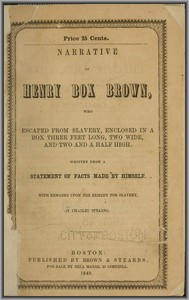
The catalog record for Narrative of Henry Box Brown Who Escaped from Slavery Enclosed in a Box 3 Feet Long and 2 Wide — Edition Insights provides practical reading context through 30,482 words, 2 hr 13 min estimated reading time, and 3 detected text sections.
The text analysis averages about 32.6 words per sentence, while the detected sections provide another way to judge how the source is divided.
Project Gutenberg metadata also associates the work with “African American abolitionists -- Biography,” connecting these edition facts with the source record’s subject description.
Explore this collection
These alternatives are selected using recorded categories and estimated reading time.
About 133 minutes
Modern Nations
30,404 recorded words. 0 minutes difference from this book's estimate.
View Gutenberg source #14086About 126 minutes
Modern Nations
28,852 recorded words. 7 minutes difference from this book's estimate.
View Gutenberg source #24307About 116 minutes
Modern Nations
26,601 recorded words. 17 minutes difference from this book's estimate.
View Gutenberg source #50549Search stored excerpts and compare books → Choose by your preferences →
Choices use stored catalog measurements. Estimates vary with reading speed. A shared category is a catalog label, not a claim that two books have the same argument or literary quality.
Search reads excerpt text stored with this catalog and links to its associated Gutenberg record. The connection is stored in the site database; this tool does not recheck that every excerpt is word-for-word identical to that external record. Excerpt search does not cover every chapter and does not verify historical publication dates.
Catalog snapshot checked: 2026-09-25. Coverage: 91 public books, 91 available source excerpts.
Read the complete public-domain text at its original source.
Read on Project GutenbergThe preface by Charles Stearns immediately frames the narrative as an instrument of moral persuasion, urging readers to let “the tear of sympathy roll freely” and to be moved to action against slavery. This rhetorical setup primes the reader for a story that is both personal testimony and political indictment. The opening pages thus establish a dual purpose: to document Brown’s suffering and to demand a response from the Northern audience.
Stearns’s preface does not simply introduce Brown; it instructs the reader on how to receive the tale. He explicitly rejects any notion of “prurient desire” or personal vanity, insisting instead that the narrative aims to “further the spread of those principles” that will end slavery. The language is urgent and biblical, calling on “Sons of the North” to arise. This opening section thus functions as a lens through which the subsequent events are to be interpreted—not as entertainment but as a call to conscience.
In the middle excerpt, Brown recounts the sale of his wife and children with stark, unadorned prose. He describes his wife “chained” in a gang, his eldest child pointing “its tiny hand” and exclaiming, “There’s my father.” The detail of the Methodist minister as purchaser adds a layer of irony. Brown’s voice here is direct and anguished, yet he also steps back to address the reader: “This is not an imaginary scene, reader; it is not a fiction.” This rhetorical move bridges personal grief and public accusation, reinforcing the preface’s moral urgency.
After the separation, Brown writes that “the first thing that occurred to me … was, thoughts of freeing myself from slavery’s iron yoke.” This transition from passive suffering to active planning marks a crucial shift in the narrative. The reader sees Brown move from a victim of circumstance to an agent of his own liberation. The later excerpt hints at the famous box escape, but the text here focuses on the psychological pivot: despair becomes determination. This section invites the reader to track how Brown’s resolve builds.
Throughout the excerpts, Brown repeatedly breaks the fourth wall, using phrases like “O reader” and “I call upon you.” This technique, inherited from the abolitionist lecture circuit, turns the narrative into a dialogue. The reader is not a passive consumer but a witness called to account. In the later passage, Brown declares he will “never refuse to advocate” for the enslaved, linking his personal story to a broader movement. For a first reading, these direct addresses are key: they signal that the book is as much about the reader’s response as about Brown’s journey.
Readers approaching this narrative for the first time should pay attention to the interplay between Stearns’s framing and Brown’s own voice. The preface sets expectations, but Brown’s direct addresses and vivid scenes often exceed that frame. Noting where Brown speaks in his own right—especially in moments of grief and resolve—reveals the narrative’s power beyond its abolitionist purpose.
Reading how Brown packed his agony into that crate, I thought of the boys in Company K, Twentieth Regiment, Illinois Volunteer Infantry Roster and Record, April 24, 1861-July 16, 1865 — A Closer Reading — different shackles, same unbearable waiting. Both books leave their silences gaping, asking me to sit with what wasn’t said. That ache lingers long after the page closes.
A brief reflection can help important ideas stay with you longer.