
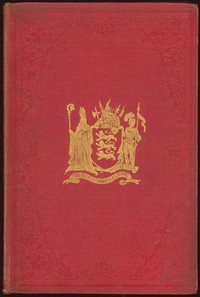
The History of England in Three Volumes, Vol.III. by Edward Farr and E. H. Nolan
Read "The History of England in Three Volumes, Vol.III. by Edward Farr and E. H. Nolan" Online
This book is available in the public domain. Start reading the digital edition below.
START READING FULL BOOKBook Preview
A short preview of the book’s content is shown below to give you an idea of its style and themes.
Let's be honest, a history book from the 1850s might sound like a dry prospect. But Edward Farr and E.H. Nolan's third volume has a surprisingly urgent energy. It covers a long, transformative century: from the rule of William and Mary in 1689, through the Hanoverian Georges, and up to the dawn of the Victorian era.
The Story
This isn't a simple list of kings and battles. The book follows England as it settles into its new political system after kicking out the last absolute monarch. You watch as political parties form, a cabinet system develops, and the power of Parliament grows. But stability at home doesn't mean peace abroad. The narrative sweeps you into the War of Spanish Succession, the Jacobite rebellions (Bonnie Prince Charlie's doomed attempt to retake the throne), and the global Seven Years' War. Running parallel to all this political and military noise is a quieter, more profound revolution: machines. The book shows how inventions for spinning and weaving didn't just change how things were made—they changed where people lived, how they worked, and sparked the first waves of social unrest from the new working class. It all culminates in the long struggle against Napoleonic France, a conflict that defined a generation.
Why You Should Read It
What makes this old history feel fresh is its focus on connections. Nolan and Farr show how a debate in Parliament could lead to a riot in London, which could influence a treaty in Europe, which then affected trade in the Americas. You see the direct line between a parliamentary act and a weaver's protest. The authors have a knack for highlighting the pivotal moments that aren't always the most famous, giving you a real sense of cause and effect. Reading it, you get a powerful sense of a society in constant, often chaotic, motion, trying to invent its future.
Final Verdict
This is perfect for the curious reader who has a basic timeline of English history but wants to understand the how and the why behind the big shifts. It's for anyone who enjoys biographies or political dramas, because that's what this era was. It's not a light beach read, but it is a deeply satisfying one. You'll finish it with a much clearer picture of how the modern world—with its politics, its industry, and its conflicts—started to take shape. Think of it as the origin story for today's Britain.
This digital edition is based on a public domain text. Feel free to use it for personal or commercial purposes.
Mary Thomas
7 months agoAs a long-time follower of this subject matter, the chapter on advanced strategies offers insights I haven't seen elsewhere. This should be on the reading list of every serious professional.
George Thomas
2 years agoIt’s refreshing to see such a high standard of digital publishing.
Richard Garcia
1 year agoOne of the most comprehensive guides I've read this year.
Christopher Gonzalez
9 months agoAs a professional in this niche, the breakdown of complex theories into digestible segments is masterfully done. Highly recommended for those seeking credible information.






Richard Hernandez
10 months agoA brilliant read that I finished in one sitting.