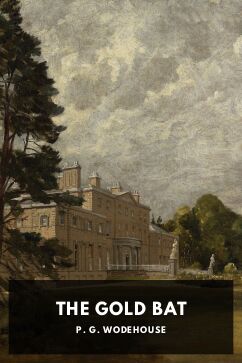
The Gold Bat - P. G. Wodehouse

(19 User reviews)   4400
By Brenda Hill Posted on Jan 27, 2026
In Category - Forensic Studies
P. G. Wodehouse P. G. Wodehouse
English
Hey, have you read Wodehouse's early stuff? I just finished 'The Gold Bat' and it's such a fun surprise. It's not about Jeeves or Blandings Castle—it's set at Wrykyn, this fictional English boarding school. The whole thing kicks off when the school's cricket captain, Trevor, gets into a massive scrape. He accidentally breaks a window at a local shop, and this sneaky schoolmate, O'Hara, spots him. O'Hara uses it as blackmail to get on the cricket team! But that's just the start. The real mystery is about the 'Gold Bat,' this tiny, jeweled trophy that gets stolen right before the big school match. Everyone thinks Trevor did it to get back at the school for his troubles. So now he's racing against time to clear his name, find the real thief, and somehow still lead his team to victory. It's got all of Wodehouse's signature wit—the dialogue is sharp and hilarious—but wrapped up in a proper schoolboy adventure with secret societies, rivalries, and a genuine whodunit. If you like clever plots and characters who dig themselves deeper with every chapter, you'll fly through this.
Share

Read "The Gold Bat - P. G. Wodehouse" Online

This book is available in the public domain. Start reading the digital edition below.

START READING FULL BOOK
Instant Access    Mobile Friendly

Book Preview

A short preview of the book’s content is shown below to give you an idea of its style and themes.

some old play.’ This story explains the genesis of this book. Like John Gilpin’s wife, it seems that though on pleasure he was bent, he had a frugal mind. He did not forget business. When reading Ben Jonson or Beaumont and Fletcher he had pencil in hand, and whenever he came to a word that might prove a stumbling-block to the general reader, he noted that word, and eventually wrote it on a separate slip (note-paper size) with exact reference and explanation. In July, 1911, in Oxford, when we were together for the last time, the professor told me about the book he was preparing—mainly consisting of the words he had collected in reading the Tudor and Stuart dramatists. He did not intend it to be a big book. When I asked whether it would contain quotations like Nares’ Glossary, he said it would contain only a few quotations, and those short ones, and would consist mostly of explanations and references, with brief etymologies. I heard no more of the book during his lifetime. But frequent letters passed between us on the etymologies of English words, many of which he was meeting with in the material he was collecting. On October 6, 1912, that eager, enthusiastic spirit passed away, to the regret of all who work in the field of English philology, of all who love the English tongue, wherever on this habitable globe they may chance to live. Not long after, in November, I heard from Mrs. Skeat that her husband had left material for a Glossary of Rare Words, in slips amounting to nearly 7,000, arranged in alphabetical order, and that Professor Skeat’s executors would be very glad if I would be able to edit and prepare the work for publication. I agreed to do this, on condition that the executors should ask the advice of a pupil of Dr. Skeat, an eminent English scholar, and also, of course, that the Delegates of the Clarendon Press would consent to the arrangement. On December 4 I received a letter from the Clarendon Press, informing me that the Delegates accepted my offer. A day or two after the box containing the MS. arrived, and on December 9 I addressed myself to the task. With the exception of a short intermission in July, the work has had my continuous and undivided attention for one year. On examination of the MS. it appeared that, although Professor Skeat had arranged the material in the form of a Glossary, he had not put the finishing touches to the book (many slips were practically duplicates or triplicates), and had not even finally limited the scope: the title of the book was not settled. And now it will be proper to state as clearly as possible what the Editor thought it his duty to do in preparing his friend’s work for publication. In the first place he did not think that it fell within his province to make any considerable addition to the Word-list. The Vocabulary remains much as Professor Skeat left it. But it was found necessary, in going over the work, to make additions in many articles, in order to explain the history of the word, or to illustrate its meaning; connecting links had to be supplied, where the meanings of a word apparently had no connexion with one another. In this part of the work the Editor found great help in the New English Dictionary; and it will be seen that there is hardly a page of this book on which there does not occur the significant abbreviation (NED.). With the same help...

This is a limited preview. Download the book to read the full content.

Before Jeeves ever polished a shoe or Bertie Wooster got into a tangle, P.G. Wodehouse was writing about life at Wrykyn School. 'The Gold Bat' is where you can see his genius starting to spark.

The Story

Trevor is the respected captain of the Wrykyn cricket team. His life gets complicated fast when he breaks a shop window. Another student, O'Hara, sees it happen and uses the secret to pressure his way onto the team. This sets off a chain of events that leads to the theft of the school's most prized possession: a tiny, jeweled cricket bat trophy. With the big match looming, Trevor becomes the prime suspect. To save his reputation and his team's spirit, he has to play detective, navigate school politics, and outsmart the real culprit—all while preparing for the most important game of the year.

Why You Should Read It

This book is a joy because you get to watch Wodehouse find his voice. The plot is tighter than some of his later, more rambling stories—it's part sports story, part mystery, and all comedy. The dialogue crackles with the dry, understated humor he's famous for. You see the early blueprint for his later masterpieces: the well-meaning hero in over his head, the absurd social rules, and the sheer fun of watching a clever plan unfold (or unravel). It's also a charming, slightly nostalgic look at boarding school life, full of rivalries, loyalties, and high-stakes trivialities that feel enormously important to the characters.

Final Verdict

This is the perfect book for a Wodehouse fan curious about his roots, or for anyone who loves a light, clever, and genuinely funny story. If you enjoy classic school tales like Tom Brown's School Days but wish they were much, much funnier, you'll love this. It's a quick, sunny read that proves Wodehouse's humor was brilliant right from the start.


✅ Public Domain Notice

This title is part of the public domain archive. Thank you for supporting open literature.

Betty Allen
2 years ago

I had low expectations initially, however it challenges the reader's perspective in an intellectual way. Exceeded all my expectations.

Linda Lopez
1 year ago

This is one of those stories where it manages to explain difficult concepts in plain English. I will read more from this author.

James Walker
3 months ago

Finally a version with clear text and no errors.

Ava Flores
2 years ago

Honestly, it manages to explain difficult concepts in plain English. I would gladly recommend this title.

Donald Moore
2 months ago

A bit long but worth it.

5
5 out of 5 (19 User reviews )

Add a Review

Your Rating *
There are no comments for this eBook.
You must log in to post a comment.
Log in


Related eBooks