About 202 minutes
Out To Win: The Story of America in France — Inside the Classic
Modern Nations
46,449 recorded words. 6 minutes difference from this book's estimate.
View Gutenberg source #15194
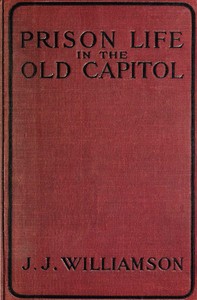
The source record for Prison Life in the Old Capitol and Reminiscences of the Civil War — Context and Discussion measures this digital text at 44,973 words, 3 hr 16 min estimated reading time, and 20 detected text sections.
The text analysis averages about 16.3 words per sentence, while the detected sections provide another way to judge how the source is divided.
Project Gutenberg metadata also associates the work with “United States -- History -- Civil War, 1861-1865 -- Prisoners and prisons,” connecting these edition facts with the source record’s subject description.
Explore this collection
These alternatives are selected using recorded categories and estimated reading time.
About 202 minutes
Modern Nations
46,449 recorded words. 6 minutes difference from this book's estimate.
View Gutenberg source #15194About 203 minutes
Modern Nations
46,656 recorded words. 7 minutes difference from this book's estimate.
View Gutenberg source #11394About 189 minutes
Modern Nations
43,428 recorded words. 7 minutes difference from this book's estimate.
View Gutenberg source #13279Search stored excerpts and compare books → Choose by your preferences →
Choices use stored catalog measurements. Estimates vary with reading speed. A shared category is a catalog label, not a claim that two books have the same argument or literary quality.
Search reads excerpt text stored with this catalog and links to its associated Gutenberg record. The connection is stored in the site database; this tool does not recheck that every excerpt is word-for-word identical to that external record. Excerpt search does not cover every chapter and does not verify historical publication dates.
Catalog snapshot checked: 2026-09-25. Coverage: 91 public books, 91 available source excerpts.
Read the complete public-domain text at its original source.
Read on Project GutenbergJames J. Williamson opens his prison diary with a deliberate narrowing of scope: he will not debate the legality of arbitrary arrests, but instead present “a picture of the daily routine of prison life as I saw it.” This choice anchors the narrative in concrete, sensory detail rather than political argument. The diary form governs the prose—entries are dated, events unfold in sequence, and the voice remains that of an observer recording what he ate, where he slept, and whom he met. Williamson’s attention to material conditions, from the hardness of a bunk to the price of whiskey, gives the account a documentary texture that distinguishes it from retrospective memoir.
The book’s reliance on dated entries shapes both its rhythm and its authority. Williamson does not smooth the raw edges of daily life into a polished narrative arc; instead, he lets the calendar dictate the flow. A typical entry records the weather, the quality of rations, and the movement of prisoners. On March 30, for example, he notes the arrival of Confederate Commissioner Robert Ould and the exchange process, but immediately follows with the mundane detail of being marched to Petersburg. This juxtaposition of high-level negotiation and bodily discomfort—cold nights, hard boards, a shared shawl—creates a texture that feels earned rather than contrived. The diary form also permits Williamson to include incidents related by others without claiming omniscience, a restraint that keeps the focus on what he witnessed firsthand.
Williamson’s vocabulary for describing scarcity is precise and varied. He does not simply say he was hungry; he explains how a biscuit could be transformed by soaking it in hot water and frying it in pork fat, calling it “a first-class luxury on a bill of fare.” The phrase “like Sam Weller’s love letter, it is too short” adds a literary reference that leavens the grimness. His account of buying whiskey at $6.50 per quart, or of negroes selling pies for a dollar each, registers the inflation and makeshift economy of the parole camp. These details are not presented as complaints but as data points, part of the “little details” he promised in the preface to show “existing conditions.” The cumulative effect is a portrait of survival that is neither heroic nor sentimental, but matter-of-fact.
In the preface, Williamson signals his intent to refute “falsehoods and misrepresentations” about Henry Wirz, the Confederate commandant of Andersonville. This is not a tangent but a thread woven into the diary’s fabric. He quotes a minister calling Wirz “a murderer” and responds by attributing such language to “ignorance rather than malice.” The parenthetical question mark after “Gospel (?)” is a pointed typographical gesture. Throughout the text, Williamson’s own experience of imprisonment—the Old Capitol, not Andersonville—serves as a counterweight to the vilification of Wirz. By documenting the routine of his own captivity, he implicitly argues that prison conditions were complex and that demonizing individuals oversimplifies history. The diary thus becomes a piece of evidence in a larger debate, though Williamson never lets the argument overwhelm the observational core.
The Old Capitol Prison itself is described only in fragments—a wharf, a railroad, a bluff—but the journey from it receives fuller treatment. Williamson’s eye for landscape is economical: at City Point he notes “high bluffs,” destroyed wharves with “charred tops of the piles,” and houses with “great holes … made by shot and shell.” These details do more than set a scene; they register the physical aftermath of war. The parole camp at Model Farm Barracks, formerly an agricultural fairground, is sketched through its makeshift quarters: twelve men in one end of an old stable, two bunks, rations of rice, sugar, salt, bacon, and three biscuits. The setting is never romanticized. Williamson’s descriptions are functional, but their very spareness conveys the provisional nature of life in a war that has not yet ended.
Readers approaching this text should expect a hybrid work: part diary, part apologia, part travelogue of the exchange route. Williamson’s voice is that of a Confederate civilian who insists on the accuracy of his own senses. The book rewards attention to its small details—the price of a pie, the feel of a cold bunk—because those details are the evidence on which his larger claims rest. It is not a comprehensive history of the Old Capitol, but a single, sustained act of witness.
That afternoon, the rain blurred the windowpanes while I read Williamson’s quiet, precise account of hunger and negotiation in the Old Capitol. His dry eye for detail made the war feel less like history and more like weather. Later, idly, I found myself turning pages in A History of Southern Missouri and Northern Arkansas Being an Account of the Early Settlements, the Civil War, the Ku-Klux, and Times of Peace — A Reader’s Guide, where the same stubborn local voices carried on, unimpressed by the wider war.
Create a short personal record of your experience with this book.