About 343 minutes
Life and Treason of Benedict Arnold — A Closer Reading
Modern Nations
78,833 recorded words. 2 minutes difference from this book's estimate.
View Gutenberg source #49500
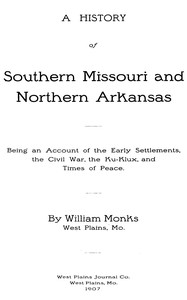
The source record for A History of Southern Missouri and Northern Arkansas Being an Account of the Early Settlements, the Civil War, the Ku-Klux, and Times of Peace — A Reader’s Guide measures this digital text at 78,379 words, 5 hr 41 min estimated reading time, and 11 detected text sections.
The text analysis averages about 26.2 words per sentence, while the detected sections provide another way to judge how the source is divided.
Project Gutenberg metadata also associates the work with “United States -- History -- Civil War, 1861-1865 -- Personal narratives,” connecting these edition facts with the source record’s subject description.
Explore this collection
These alternatives are selected using recorded categories and estimated reading time.
About 343 minutes
Modern Nations
78,833 recorded words. 2 minutes difference from this book's estimate.
View Gutenberg source #49500About 349 minutes
Modern Nations
80,192 recorded words. 8 minutes difference from this book's estimate.
View Gutenberg source #39954About 360 minutes
Modern Nations
82,736 recorded words. 19 minutes difference from this book's estimate.
View Gutenberg source #11008Search stored excerpts and compare books → Choose by your preferences →
Choices use stored catalog measurements. Estimates vary with reading speed. A shared category is a catalog label, not a claim that two books have the same argument or literary quality.
Search reads excerpt text stored with this catalog and links to its associated Gutenberg record. The connection is stored in the site database; this tool does not recheck that every excerpt is word-for-word identical to that external record. Excerpt search does not cover every chapter and does not verify historical publication dates.
Catalog snapshot checked: 2026-09-25. Coverage: 91 public books, 91 available source excerpts.
Read the complete public-domain text at its original source.
Read on Project GutenbergWilliam Monks opens his 1907 memoir not with a battle but with a flatboat. Born in Alabama, he recalls watching Cherokee removal on the Tennessee River before his family settled in southern Illinois. This early memory of displacement and border-crossing sets the pattern for a narrative that moves constantly between Union and Confederate lines, between settled farms and guerrilla trails. Monks writes as a participant—a Union scout who reads horse tracks, counts nails in shoes, and adopts false names under cocked pistols. His account is less a formal history than a veteran's testimony, shaped by the specific geography of the Missouri-Arkansas border and the intimate violence of irregular war.
Monks's narrative is built around reconnaissance missions where identity itself becomes a weapon. Ordered to learn rebel movements, he travels by night, approaches houses after dark, and relies on men like Andy Smith—a Union sympathizer who feigns Confederate loyalty. When Monks and his companion Long are stopped by armed men in civilian dress, they instantly invent false names: Williams and Tucker. The scene is tense and absurd: ordered to strip at gunpoint, Monks cannot help laughing at Long's distress over a five-dollar pair of boots. Such moments reveal a world where survival depends on quick lies and sharp observation—reading the three-nail shoe pattern of Burbrage's command, or noting white hat bands meant to distinguish state militia from rebels. The border region is a landscape of masks, where every encounter carries the threat of exposure.
Monks does not limit his account to military maneuvers. The excerpt shows civilians caught between armies: a woman cheers Burbrage's men, shouting that the Yankees and 'lopeared Dutch' will now be cleaned out. Her exclamation is recorded without comment, but it underscores how the war divided communities along lines of loyalty, ethnicity, and class. Monks himself moves through a countryside where a man might be Union at heart but rebel in public, where a house can offer food one night and betrayal the next. The memoir's structure—moving from early settlements through Civil War to Ku Klux Klan violence—suggests that the conflict did not end with Appomattox. The same borderlands that hosted guerrilla raids later saw the Klan's campaign to overturn Reconstruction, a continuity Monks documents from his own experience.
Monks writes in the third person, referring to himself as 'the author' throughout. This stylistic choice distances the narrator from the younger man who rode those trails, yet the text is filled with sensory detail: the feel of a forced march, the sight of horse tracks, the sound of a woman's voice. The memoir is not a polished retrospective but a collection of scenes held together by the author's physical presence. He remembers the exact location of a house, the name of a contact, the route of a trail. This granularity gives the account its evidentiary weight, even as Monks acknowledges gaps—he does not claim to know the full story of Burbrage's raid, only what he saw and heard. The result is a document that feels less like a history than a deposition, sworn by a man who was there.
Readers should approach Monks's text as a primary source shaped by memory, grievance, and the conventions of early twentieth-century memoir. His perspective is explicitly Unionist, and his account of the Klan reflects the political battles of the 1900s as much as the 1860s. The book rewards attention to its small details—the cost of boots, the color of hat bands, the names of obscure creeks—because those details anchor a larger story of survival in a region where the war never really ended.
Reading Monks’s account of Ozark guerrillas, I kept thinking about the quiet domesticity he left behind—the farms and gardens his war shattered. That made me recall a different wartime memoir, one where blockade meant mending clothes and making lye soap from ashes. A Blockaded Family: Life in Southern Alabama during the Civil War — Text and Context holds that same ache of ordinary life persisting through extraordinary ruin, though from the other side.
Create a short personal record of your experience with this book.