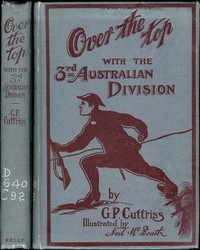
Cuttriss opens his preface by disclaiming literary merit and historical ambition, stating the volume is merely a response to requests from the 'boys.' He explicitly omits training, raids, and tactics, aiming instead to capture the 'big-hearted, devil-may-care style' of Australian soldiers. The dedication—a verse vowing 'we'll win this fight'—sets a resolute, patriotic tone. Sir John Monash's introduction frames the Australian soldier as an 'unknown quantity' at war's outbreak, hinting at the reputation-building that follows.
From Disclaimer to Dedication
The preface and dedication establish the book's informal purpose. Cuttriss writes that the work 'makes no pretension to literary merit' and was prepared 'amidst the trying and thrilling experiences so common to active service.' He suppresses place and personal names per censorship, but insists this will not detract from interest. The dedication's verse—'As sure as God's in heaven'—frames the conflict in moral absolutes. Monash's introduction then provides a broader context, noting that prior Australian contributions in Sudan and South Africa were 'no true index' of national capacity. Together, these opening pages signal a personal, anecdotal account rather than a formal history.
Two Extremes of Humanity in No Man's Land
In one excerpt, a raiding party hears a cry from no man's land. German troops turn a searchlight on the wounded man, guiding Australian stretcher-bearers to rescue him without firing a shot. Cuttriss calls this 'a humane action indeed.' Immediately afterward, he recounts a second raid where Germans stripped a wounded soldier, left him against the wire, and he died of exposure. The author contrasts these as 'the two extremes in the attitude of the Huns.' He refrains from attributing brutality to official sanction, instead interpreting 'frightfulness' as evidence of desperation. This pairing of anecdotes—without broader tactical detail—exemplifies the book's method: concrete incidents that illustrate moral character.
Cellar Humour Under Shellfire
A later excerpt describes a billet in a town under shelling. After midnight, shrapnel rains on the roof; the commanding officer decides discretion is better than valour, and the men descend to the cellar with electric torches. Cuttriss notes that 'everybody was cheerful.' They listen for the 'swish of the shells' and chorus 'Another one in' as each explodes. He compares this to Bairnsfather's sketches, claiming they are 'in no particular exaggerated.' The scene captures the blend of danger and dark humour that pervades the narrative. The author's focus remains on the men's reactions—sympathy for those hit, and a collective, almost theatrical, response to the bombardment.
Vandalism and the Civilian Cost
Cuttriss observes that the enemy concentrates artillery on towns and villages behind the lines, reducing them to ruins. He states this destruction is 'of no military consequence' and calls it 'pure vandalism.' This remark, placed between anecdotes of trench raids and cellar vigils, shifts the reader's attention to the broader landscape of war—the obliterated civilian spaces that form the backdrop to the soldiers' daily life. The author does not elaborate on strategic rationale; instead, he presents the devastation as a fact of the environment, reinforcing the sense of a war that reaches beyond the front lines. The passage underscores the book's interest in the experiential rather than the tactical.
Cuttriss's volume is best approached as a series of vignettes rather than a continuous narrative. Readers will find that the author's deliberate omission of dates, places, and unit movements frees him to focus on mood and character. The excerpts suggest that the book's value lies in its accumulation of small, telling moments—a searchlight in no man's land, a chorus in a cellar—rather than in any overarching argument. Those seeking a linear history should look elsewhere; those interested in the texture of trench life, as seen through one soldier's eyes, will find a candid, if limited, record.
The rain kept time with the mud-splattered pages of Over the Top, its dry humor a warm lamp against the grey. That same quiet stubbornness—men holding to themselves when everything else falls away—stayed with me, turning over until it landed, oddly, on Life and Treason of Benedict Arnold — A Closer Reading. Both are about the weight of a choice, kept privately, long after the noise dies down.