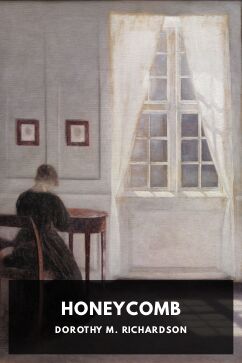
Honeycomb - Dorothy M. Richardson

(18 User reviews)   3322
By Brenda Hill Posted on Jan 27, 2026
In Category - Forensic Studies
Dorothy M. Richardson Dorothy M. Richardson
English
Hey, have you heard about 'Honeycomb'? It’s this wild, early 20th-century novel that basically invents a new way of writing. Forget plot twists and big events—this book is all about the main character, Miriam, just *thinking*. We follow her from being a governess to moving to London, and the whole story unfolds through her stream of consciousness. It’s like being inside someone’s head, listening to every observation, every flicker of memory, every reaction to the world. The 'conflict' isn't a villain or a mystery; it’s the quiet, intense battle of a young woman trying to figure out who she is and how she fits into a society that doesn’t really have a place for her. It’s a slow burn, but if you’re up for a completely immersive, psychological deep-dive into a fascinating mind, this is your book. It’s challenging, but in the best, most rewarding way.
Share

Read "Honeycomb - Dorothy M. Richardson" Online

This book is available in the public domain. Start reading the digital edition below.

START READING FULL BOOK
Instant Access    Mobile Friendly

Book Preview

A short preview of the book’s content is shown below to give you an idea of its style and themes.

But the house was two miles off. She was safe for the present. Throughout the journey from London the two-mile drive from the station had stood between her and the house. The journey was a long solitary adventure; endless; shielded from thoughts of the new life ahead and leaving the past winter in the Gunnersbury villa far away; vanquished, almost forgotten. She could only recall the hours she had spent shivering apathetically over small fires; a moment when she had brought a flush of tears to her mother’s eyes by suddenly telling her she was maddeningly unreasonable, and another moment alone with her father when she had stood in the middle of the hearth-rug with her hands behind her and ordered him to abstain from argument with her in the presence of her mother--“because it gives her pain when I have to show you that I am at least as right as you are”--and he had stood cowed and silent.... Then the moment of accepting the new post, the last days of fear and isolation and helplessness in hard winter weather and the setting off in the main line train that had carried her away from everything--into the spring. Sitting in the shabbily upholstered unexpectedly warm and comfortable main line train she had seen through the mild muggy air bare woods on the horizon, warm and tawny, and on the near copses a ruddy purpling bloom. Surprise had kept her thoughtless and rapt. Spring--a sudden pang of tender green seen in suburban roadways in April ... one day in the Easter holidays, bringing back the forgotten summer and showing you the whole picture of summer and autumn in one moment ... but evidently there was another spring, much more real and wonderful that she had not known--not a clear green thing, surprising and somehow disappointing you, giving you one moment and then rushing your thoughts on through vistas of leafage, but tawny and purple gleamings through soft mist, promising ... a vision of spring in dim rich faint colours, with the noisy real rushing spring still to come ... a thing you could look at and forget; go back into winter, and see again and again, something to remember when the green spring came, and to think of in the autumn ... spring; coming; perhaps spring was coming all the year round.... She looked back, wondering. This was not the first time that she had been in the country in March. Two years ago, when she had first gone out into the world it had been March ... the night journey from Barnes to London, and on down to Harwich, the crossing in a snowstorm, the afternoon journey across Holland--grey sky, flat bright green fields, long rows of skeleton poplars. But it was dark before they reached the wooded German country--the spring must have been there, in the darkness. And now coming to Newlands she had seen it. The awful blind cold effort of coming to Newlands had brought a new month of spring; there for always.... And this was the actual breath of it; here, going through her in the darkness.... Someone was at her side, murmuring her name, a footman. She moved with him towards a near patch of light which they reached without going through the station building, and in a moment the door of a little brougham closed upon her with a soft thud. She sat in the softly lit interior, holding her umbrella and her undelivered railway ticket in careful fingers. The footman and a porter were hoisting her Saratoga trunk. Their movements sounded muffled...

This is a limited preview. Download the book to read the full content.

So, let's talk about Dorothy M. Richardson's 'Honeycomb'. Published in 1917, it's the third book in her massive 13-volume series, Pilgrimage, but you can absolutely jump in here. It's often called one of the first true 'stream of consciousness' novels in English, and after reading it, you'll see why.

The Story

The story follows Miriam Henderson, a young woman in her early twenties. She's left her job as a governess in Germany and is now living in London, navigating a world of boarding houses, new acquaintances, and the buzzing intellectual life of the city. But don't expect a traditional plot. The 'action' is almost entirely internal. We experience London—its streets, its conversations, its oppressive atmosphere—through the relentless, unfiltered flow of Miriam's thoughts, impressions, and memories. A simple walk becomes a cascade of sensory details and personal associations. A conversation isn't just dialogue; it's Miriam's analysis of every word, every tone, every social nuance. The book captures the fragmented, overwhelming, and deeply personal experience of being a thoughtful person in a modern world.

Why You Should Read It

I'll be honest: this isn't a breezy beach read. It demands your attention. But what you get in return is something extraordinary. Richardson pulls off a magic trick—she makes you feel what it's like to be Miriam. You're not just told she's intelligent and sensitive; you experience the world with her intensity. The writing is dense and poetic, but it's also incredibly honest about female experience at the time. Miriam's struggle isn't against a person, but against the limitations placed on her, the expectations she must quietly resist. Reading Honeycomb feels like discovering a secret history of the inner life.

Final Verdict

This book is perfect for readers who love character studies and aren't afraid of a literary challenge. If you enjoyed the psychological depth of Virginia Woolf (who was inspired by Richardson!) or the immersive style of James Joyce, you need to meet Dorothy Richardson. It's also a must-read for anyone interested in the roots of feminist literature or the history of the novel itself. Give yourself permission to sink into its rhythm. You might just find, as I did, that Miriam's voice stays with you long after you've turned the last page.


⚖️ Public Domain Notice

This is a copyright-free edition. Feel free to use it for personal or commercial purposes.

Andrew Nguyen
6 months ago

After finishing this book, the clarity of the writing makes this accessible. A true masterpiece.

Brian Johnson
2 months ago

Recommended.

Margaret Brown
1 year ago

Without a doubt, the storytelling feels authentic and emotionally grounded. A true masterpiece.

Jessica Hill
1 year ago

Clear and concise.

Lucas Thomas
1 month ago

Wow.

4.5
4.5 out of 5 (18 User reviews )

Add a Review

Your Rating *
There are no comments for this eBook.
You must log in to post a comment.
Log in


Related eBooks