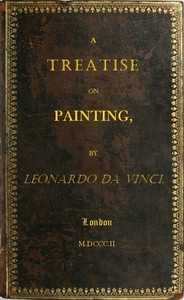
A Treatise on Painting by da Vinci Leonardo

(19 User reviews)   4648
By Brenda Hill Posted on Jan 13, 2026
In Category - Forensic Studies
Leonardo, da Vinci, 1452-1519 Leonardo, da Vinci, 1452-1519
English
Okay, hear me out. You know Leonardo da Vinci was a genius, right? The Mona Lisa, the flying machines... but what if I told you he wrote a book? Not just any book, but his personal instruction manual on how to see and create art. 'A Treatise on Painting' isn't a dry textbook. It's like finding his private workshop notes. The real hook? It’s not really about painting techniques in the way you'd think. It’s about the grand mystery of how to truly see the world. Leonardo argues that to paint a thing, you must first understand it—its light, its shadow, its very soul. The book is his attempt to solve that puzzle: How do you capture the living, breathing reality of a person, a storm cloud, or a falling leaf onto a flat, silent canvas? Reading it feels like getting a masterclass from the man himself, 500 years later. It’s less about brushstrokes and more about training your eyes and mind. If you've ever looked at a painting and wondered 'How did they do that?' this book gives you the answer straight from the ultimate source.
Share

Read "A Treatise on Painting by da Vinci Leonardo" Online

This book is available in the public domain. Start reading the digital edition below.

START READING FULL BOOK
Instant Access    Mobile Friendly

Book Preview

A short preview of the book’s content is shown below to give you an idea of its style and themes.

print, as well as minor punctuation errors have been tacitly corrected. In the text, the plates are referenced by using Roman numerals, whereas the captions of the plates show Arabic numerals; the same applies to the Table of Chapters and the chapter headings, respectively. This inconsistency has been retained. Footnotes related to introductory chapters have been prefixed with the letter 'i' ([i1]-[i210]); footnotes in da Vinci's own text, however, are shown in plain Arabic numerals ([1]-[102]). Italic passages in the original version have been placed between underscores (_text_); text in small caps has been symbolised by forward slashes (/small caps/). A superscript character has been denominated by a preceding caret symbol (^). The following typographical errors have been corrected: # p. xviii: 'overspead' --> 'overspread'; 'Vincius ast oculis' --> 'Vincius est oculis' # p. lxxxiii: 'Vasari, 36,' --> 'Vasari, p. 36' # p. lxxxv: 'Maestrodi' --> 'Maestro di' # p. xcii: 'Fontainbleau' --> 'Fontainebleau' # p. 22: Plate 2: original caption points to page 2; corrected to page 22. # p. 37: 'pully' -->'pulley' # p. 117: 'andso' --> 'and so' # p. 156: 'A B E D' --> 'C B E D' # p. 181: 'that that' --> 'than that' # Footnote 62: 'tranferred' --> 'transferred' The Table of Chapters has been moved to the beginning of the text for reasons of clarity and comprehensibility. A TREATISE ON PAINTING, BY LEONARDO DA VINCI. Printed by /S. Gosnell/, Little Queen Street, Holborn, London. [Illustration: LEONARDO DA VINCI, from a Picture In the Florentine Museum. _London, Published by J. Taylor 59 High Holborn_] A TREATISE ON PAINTING, BY _LEONARDO DA VINCI_. FAITHFULLY TRANSLATED FROM THE ORIGINAL ITALIAN, AND NOW FIRST DIGESTED UNDER PROPER HEADS, /By/ JOHN FRANCIS RIGAUD, /Esq./ ACADEMICIAN OF THE ROYAL ACADEMY OF PAINTING AT LONDON, AND ALSO OF THE ACADEMIA CLEMENTINA AT BOLOGNA, AND THE ROYAL ACADEMY AT STOCKHOLM. Illustrated with twenty-three Copper-plates, and other Figures. TO WHICH IS PREFIXED _A NEW LIFE OF THE AUTHOR_, DRAWN UP FROM AUTHENTIC MATERIALS TILL NOW INACCESSIBLE, /By/ JOHN SIDNEY, HAWKINS, /Esq./ F.A.S. Ars est habitus quidam faciendi verâ cum ratione. ARISTOT. ETHIC. LIB. 6. London: PRINTED FOR J. TAYLOR, AT THE ARCHITECTURAL LIBRARY, HIGH HOLBORN. M.DCCC.II. TABLE OF CHAPTERS. _The Number at the End of each Title refers to the corresponding Chapter in the original Edition in Italian._ DRAWING. PROPORTION. Chap. 1. What the young Student in Painting ought in the first Place to learn. Chapter 1. 2. Rule for a young Student in Painting. 3. 3. How to discover a young Man's Disposition for Painting. 4. 4. Of Painting, and its Divisions. 47. 5. Division of the Figure. 48. 6. Proportion of Members. 49. 7. Of Dimensions in general. 173. 8. Motion, Changes, and Proportion of Members. 166. 9. The Difference of Proportion between Children and grown Men. 169. 10. The Alterations in the Proportion of the human Body from Infancy to full Age. 167. 11. Of the Proportion of Members. 175. 12. That every Part be proportioned to its Whole. 250. 13. Of the Proportion of the Members. 185. 14. The Danger of forming an erroneous Judgment in regard to the Proportion and Beauty of the Parts. 42. 15. Another Precept. 12. 16. The Manner of drawing from Relievos, and rendering Paper fit for it. 127. 17. Of drawing from Casts or Nature. 31. 18. To draw Figures from Nature. 38. 19. Of drawing from Nature. 25. 20. Of drawing Academy Figures. 30. 21. Of studying in the Dark, on first waking in the Morning, and before going to sleep. 17. 22. Observations on drawing Portraits. 188. 23....

This is a limited preview. Download the book to read the full content.

Let's be clear from the start: this isn't a novel. You won't find a plot with heroes and villains. Instead, think of it as the ultimate behind-the-scenes documentary. 'A Treatise on Painting' is Leonardo's brain, spilled out onto the page. He organized his thoughts (well, as much as Leonardo ever organized anything) into sections that build from the ground up.

The Story

The 'story' is the journey of becoming an artist, as told by the Renaissance's ultimate overachiever. It starts with the basics—how to train a young student, the importance of drawing. Then, it zooms out. Leonardo doesn't just teach you how to paint a nose; he explains why shadows fall a certain way on it, how light from a window changes its color, and how its shape relates to the bones and muscles underneath. He moves from human figures to landscapes, animals, and even how to depict things like rain, smoke, and dust in the air. The central thread is his obsession with observation. For him, the painter isn't just a decorator, but a philosopher with a brush, someone who investigates the very laws of nature.

Why You Should Read It

This book is a shock to the system. In our world of quick snaps and filters, Leonardo demands slow, deep looking. My biggest takeaway wasn't a painting tip—it was a life tip. His idea that 'the painter must be universal' pushed me to look closer at everything: the way tree branches fork, the subtle colors in a puddle, how people's postures tell their stories. You get this intimate, sometimes frustratingly scattered, conversation with genius. You see his curiosity explode on every page, whether he's comparing the veins in a leaf to rivers on a map or explaining why you should stare at stained walls to spark your imagination. It makes you feel smarter, more connected to the world.

Final Verdict

This is a must for any creative person, not just painters. Writers, photographers, designers—anyone who wants to sharpen their observation skills will find gold here. It's also perfect for history and science nerds who want to see how one of the greatest minds in history connected art and nature. A word of warning: it's not a light beach read. Some passages get very technical. My advice? Don't try to read it cover-to-cover like a novel. Dip in and out. Read a few pages, then go for a walk and try to see the light the way he describes. It's a book to live with, not just read.


🔖 Free to Use

This historical work is free of copyright protections. It is available for public use and education.

David Smith
2 months ago

Fast paced, good book.

Thomas Jackson
4 months ago

Clear and concise.

Jessica Flores
1 year ago

After hearing about this author multiple times, the character development leaves a lasting impact. I couldn't put it down.

Robert Davis
1 year ago

Just what I was looking for.

Michael Garcia
8 months ago

If you enjoy this genre, the character development leaves a lasting impact. A true masterpiece.

4.5
4.5 out of 5 (19 User reviews )

Add a Review

Your Rating *
There are no comments for this eBook.
You must log in to post a comment.
Log in


Related eBooks