About 189 minutes
A Yankee in the Trenches — Inside the Classic
Modern Nations
43,428 recorded words. 24 minutes difference from this book's estimate.
View Gutenberg source #13279
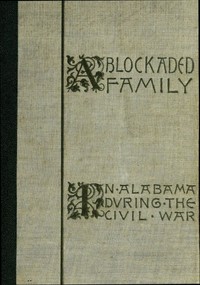
Before opening A Blockaded Family: Life in Southern Alabama during the Civil War — Text and Context, the edition data offers a quick orientation: 37,929 words, 2 hr 45 min estimated reading time, and 16 detected text sections.
The text analysis averages about 27.8 words per sentence, while the detected sections provide another way to judge how the source is divided.
Project Gutenberg metadata also associates the work with “United States -- History -- Civil War, 1861-1865 -- Blockades,” connecting these edition facts with the source record’s subject description.
Explore this collection
These alternatives are selected using recorded categories and estimated reading time.
About 189 minutes
Modern Nations
43,428 recorded words. 24 minutes difference from this book's estimate.
View Gutenberg source #13279About 189 minutes
Modern Nations
43,241 recorded words. 24 minutes difference from this book's estimate.
View Gutenberg source #24972About 196 minutes
Modern Nations
44,973 recorded words. 31 minutes difference from this book's estimate.
View Gutenberg source #66470Search stored excerpts and compare books → Choose by your preferences →
Choices use stored catalog measurements. Estimates vary with reading speed. A shared category is a catalog label, not a claim that two books have the same argument or literary quality.
Search reads excerpt text stored with this catalog and links to its associated Gutenberg record. The connection is stored in the site database; this tool does not recheck that every excerpt is word-for-word identical to that external record. Excerpt search does not cover every chapter and does not verify historical publication dates.
Catalog snapshot checked: 2026-09-25. Coverage: 91 public books, 91 available source excerpts.
Read the complete public-domain text at its original source.
Read on Project GutenbergParthenia Antoinette Hague opens her 1888 memoir not with a declaration of war but with a schoolteacher walking toward a plantation schoolhouse near Eufaula, Alabama, on a morning in early summer 1861. A letter from her father announces that her brothers are preparing to leave for Richmond. This quiet, personal beginning establishes the book's method: large historical forces are registered through the routines of a single household. The narrative that follows is less a chronicle of battles than a detailed account of how one family and its neighbors met the material shortages imposed by the Union blockade.
Hague's prose is direct and observational, often pausing to describe the exact steps for dyeing thread with sweet-gum bark or weaving a "dice" pattern on a four-treadle loom. The book's value lies in this specificity: it records techniques that oral tradition might have lost, from making pasteboard buttons to crocheting braid from thread when manufactured tape was unavailable.
Hague's diction is consistently practical, favoring verbs of craft: carded, spun, woven, dyed, crocheted, braided. She names materials with precision—"sweet-gum and maple trees" for gray dye, "number twelve thread" from Columbus mills, "lint cotton" dyed in two shades of blue. This vocabulary does more than describe; it establishes the author as a knowledgeable participant in the work she records. She does not simply report that cloth was made; she explains that "salt-and-pepper cloth" required alternating one white thread and one black thread in both warp and woof, a slow process because "the shuttles, with the quills of black and white thread, were changed at every tap of the batten." The rhythm of that sentence mimics the weaver's repetitive motion.
When Hague shifts from description to reflection, her language becomes more abstract and occasionally jarring. The assertion that Southerners' adaptability proved "blood will tell" sits uneasily beside the meticulous, race-neutral accounts of technique. These moments of overt ideology are rare; the book's enduring texture comes from the concrete, unglamorous details of making do.
Direct speech is sparse in A Blockaded Family. The opening scene includes a child's exclamation—"Here is a letter for you, Miss A——!"—and later chapters mention slaves' speech in passing, but Hague does not reconstruct extended conversations. This absence is itself a choice. The narrative voice remains firmly that of the white plantation mistress or teacher, reporting what she saw and did. Enslaved people appear as figures in the landscape: "the negro boy who was sent every morning for the mail" is named only as "Ed" in parentheses. Their labor is acknowledged—Aunt Phillis and Uncle Ben have chapters named after them—but their perspectives are not rendered in dialogue.
Hague's reticence with speech may reflect the memoir's origins as a postwar publication aimed at a Northern audience, or simply the conventions of the form. What the book does record, in its own voice, is a world where every object—a dress, a button, a cup of raspberry-leaf tea—carries the story of its making.
The chapter titles read like a catalog of domestic manufacture: "How Cloth was dyed—How Shoes, Thread, Hats, and Bonnets were manufactured," "Substitutes for Coffee—Raspberry-leaf Tea—Home-made Starch, Putty, and Cement." This organizational scheme prioritizes process over chronology. The book does not move steadily from 1861 to 1865; instead, it circles through categories of need—cloth, dye, food, clothing—returning to the loom in multiple chapters.
Within this structure, Hague often pauses to quantify. She notes that a trip to Columbus, Georgia, for thread was "fifty miles from our settlement, and generally a three days' trip." She specifies that plaids "required three and four shuttles and as many varieties of color." These numbers ground the narrative in the physical constraints of distance and labor. The effect is less a story than an archive of techniques, organized by material rather than by event.
Certain objects recur with the insistence of memory: the pasteboard button covered with silk, the crocheted chain braided onto a dress, the shuttle changed at every tap of the batten. Hague returns to the problem of buttons several times, describing how they were made from scraps of cloth or pasteboard and covered with matching fabric. These small, repeated details accumulate into a portrait of scarcity that is neither sentimental nor dramatic. The blockade is not a backdrop; it is the condition that makes every button a problem to be solved.
Hague also notes what was not available: "braid and tape could not be bought, nor could we weave that sufficiently narrow." The absence of manufactured goods is as present in the text as the substitutes that replaced them. This attention to the missing—the thing that had to be invented because it could not be purchased—gives the memoir its particular texture of loss and ingenuity.
Readers approaching A Blockaded Family for narrative sweep will find instead a methodical record of making. Hague's memoir rewards attention to its technical passages, where the steps for dyeing with sweet-gum bark or weaving a basket plait are laid out with the clarity of a manual. The book's value lies in these specifics, not in its occasional forays into sectional apology. For those interested in the material culture of the Civil War home front, it offers a rare, firsthand account of how one household transformed scarcity into a kind of craft.
Reading Parthenia Hague’s patient descriptions of weaving looms from scrap wood and boiling walnut hulls for dye, I found myself drifting back to another quiet volume on my shelf, The Soul of the War — Reading Companion. Both feel less like grand histories and more like murmured letters home—small, stubborn records of what people make when everything else is stripped away.
Create a short personal record of your experience with this book.