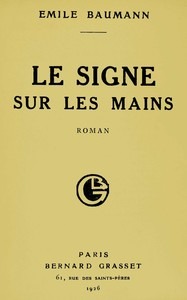
Le signe sur les mains : roman by Emile Baumann

(30 User reviews)   8839
By Brenda Hill Posted on Dec 21, 2025
In Category - Medical Research
Baumann, Emile, 1868-1942 Baumann, Emile, 1868-1942
French
Imagine this: a young priest arrives in a small French town, ready to serve his flock. But he carries a strange mark on his hands—a mark some say is a holy sign, and others whisper is something far darker. Emile Baumann's novel isn't just a story about faith; it's a tense, psychological drama about perception and power. The whole village watches, judges, and projects their own hopes and fears onto this one man. Is he a saint or a fraud? The answer depends entirely on who you ask. It's a quiet, gripping book that asks big questions about belief and the stories we need to believe in.
Share

Read "Le signe sur les mains : roman by Emile Baumann" Online

This book is available in the public domain. Start reading the digital edition below.

START READING FULL BOOK
Instant Access    Mobile Friendly

Book Preview

A short preview of the book’s content is shown below to give you an idea of its style and themes.

LE BAPTÊME DE PAULINE ARDEL, roman (Bernard Grasset, éditeur). L’ABBÉ CHEVOLEAU, CAPORAL AU 90e D’INFANTERIE (Perrin, éditeur). LA PAIX DU SEPTIÈME JOUR (Perrin, éditeur). LE FER SUR L’ENCLUME (Perrin, éditeur). JOB LE PRÉDESTINÉ, roman (Bernard Grasset, éditeur). L’ANNEAU D’OR DES GRANDS MYSTIQUES (Bernard Grasset, éditeur). SAINT PAUL (Bernard Grasset, éditeur). Édition de luxe: HEURES D’ÉTÉ AU MONT SAINT-MICHEL, avec des gravures sur bois de René Pottier. IL A ÉTÉ TIRÉ DE CET OUVRAGE: TREIZE EXEMPLAIRES SUR PAPIER JAPON, DONT DIX NUMÉROTÉS JAPON 1 à 10 ET TROIS, JAPON H. C. I à H. C. III; TRENTE-SIX EXEMPLAIRES SUR PAPIER HOLLANDE, DONT TRENTE NUMÉROTÉS HOLLANDE 1 à 30 ET SIX, HOLLANDE H. C. I à H. C. VI; ET CENT TRENTE-CINQ EXEMPLAIRES SUR PAPIER VÉLIN PUR FIL LAFUMA, DONT CENT VINGT-CINQ NUMÉROTÉS VÉLIN PUR FIL 1 à 125 ET DIX, VÉLIN PUR FIL H. C. I à H. C. X. Tous droits de traduction, de reproduction et d’adaptation réservés pour tous pays. Copyright by Bernard Grasset 1926. A Mademoiselle GENEVIÈVE DUHAMELET après avoir relu ses Poèmes; Agnès les eût aimés. AUX JEUNES AMIS CONNUS ET INCONNUS qui retrouveront en Jérôme quelque chose d’eux-mêmes. I Au moment où Jérôme entra, rue de Vaugirard, dans la chapelle des Carmes, l’office du Samedi Saint était commencé. Comme tous les ans, la veille de Pâques, on y faisait l’ordination des clercs. Devant le tabernacle se tenait agenouillé, en chape violette, avec ses assistants, un majestueux évêque dont un acolyte portait la crosse. Les surplis des prêtres emplissaient le chœur; des têtes chauves brillaient sous le soleil qui pénétrait, à droite, par le vitrail du transept. Les yeux de Jérôme ne se tendirent qu’une minute vers l’autel. Au milieu de la nef, la double rangée des ordinands formait en demi-cercle une couronne d’aubes et de cierges, le long d’un tapis où, solennellement, s’avancèrent ceux qui allaient être ordonnés, les uns sous-diacres, les autres diacres, quelques-uns, prêtres. Ils se mirent à genoux, puis, les mains croisées sous leur front, ils s’allongèrent, demeurèrent immobiles. Le clergé avait entonné les litanies des Saints; l’Église triomphante s’entendait appeler à soutenir de sa puissance l’infirmité des médiateurs terrestres. Eux, avant de se lier par les rites irrévocables, ils signifiaient leur volonté de mourir à tout ce qui n’était pas Dieu; ils restaient couchés là, pareils à des cadavres, comme de grands lys foudroyés. Jérôme, leste et mince, pour mieux voir, s’insinua entre les chaises pressées des fidèles, jusqu’au centre de la nef. Il considéra ces corps de jeunes hommes, prostrés en ligne, sur deux rangs. Les diacres, par-dessus leur aube, étaient ceints d’une étole, comme des soldats d’un baudrier. La couleur rouge étalée dans l’or du tapis lui représenta des flaques sinueuses de sang, le sang frais de combattants abattus, la face dans la poussière, parmi des blés qui mûrissent. Il songea: --Si Montcalm était ici... Montcalm, son aîné de deux ans, un camarade tué à la guerre, cinq mois avant la fin; une de ces amitiés que le silence de la mort approfondit! «Qu’est-ce qu’un mort? a dit quelqu’un. _Un absent qui n’écrit plus._» Montcalm avait-il besoin d’écrire? Quand était-il absent? Depuis l’heure où il partit en patrouille et ne reparut jamais, Jérôme gardait comme gravé au couteau dans sa mémoire son regard d’adieu; même le son de ses dernières paroles vibrait en lui. A Moulin-sous-Touvent, le soir du 3 juin, au crépuscule, ils marchaient l’un derrière l’autre, le long d’un boyau fangeux. Montcalm s’avançait le premier, penchant la tête, massif et grave. Un brusque pressentiment le saisit; il s’arrêta, se retourna, dit à Jérôme: --Tu sais où je dois...

This is a limited preview. Download the book to read the full content.

I just finished a book that's been quietly haunting my thoughts. It's not a flashy thriller, but it has the slow-burn tension of one.

The Story

We follow a young priest, Jean, who is assigned to a rural French parish. He's earnest and devout, but he bears a peculiar physical mark on his hands. From the moment he arrives, this 'sign' becomes the center of everything. Some villagers see it as a miracle, proof of God's favor. Others view it with suspicion, a possible trick or even a curse. The novel unfolds through the eyes of the community—the devout, the skeptical, the envious—as they project their own spiritual longings and personal dramas onto Jean. The real conflict isn't about the mark itself, but about what people choose to see in it.

Why You Should Read It

Baumann writes with incredible subtlety. He doesn't tell you what to think. Instead, he masterfully shows how a single, ambiguous detail can fracture a community. Jean is a fascinating character because he's almost a blank canvas. The drama comes from the paint others throw on him. It made me think about how quickly we create narratives around people, especially those in positions of spiritual authority. The writing is precise and atmospheric, pulling you completely into the mood of this isolated town.

Final Verdict

This is a book for readers who love character-driven stories and moral ambiguity. If you enjoyed the quiet tension of Marilynne Robinson's Gilead or the psychological depth of a Georges Bernanos novel, you'll find a lot to love here. It's a slow, thoughtful read that sticks with you, perfect for anyone who likes fiction that explores the messy intersection of faith, community, and human nature.


📜 Public Domain Content

This text is dedicated to the public domain. It is now common property for all to enjoy.

Emily Torres
1 year ago

Finally found time to read this!

Linda Moore
1 year ago

Finally found time to read this!

Carol Ramirez
1 year ago

Text is crisp, making it easy to focus.

Elijah Anderson
6 months ago

I was skeptical at first, but the arguments are well-supported by credible references. This story will stay with me.

Oliver Brown
6 months ago

Without a doubt, it challenges the reader's perspective in an intellectual way. Absolutely essential reading.

5
5 out of 5 (30 User reviews )

Add a Review

Your Rating *
There are no comments for this eBook.
You must log in to post a comment.
Log in


Related eBooks