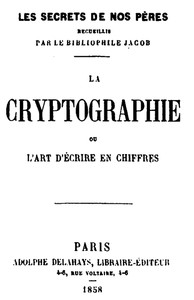
La Cryptographie, ou, l'art d'écrire en chiffres by P. L. Jacob

(23 User reviews)   6124
By Brenda Hill Posted on Jan 13, 2026
In Category - Medical Research
Jacob, P. L., 1806-1884 Jacob, P. L., 1806-1884
French
Hey, have you ever wondered how people kept secrets before computers? I just read this fascinating old book from the 1840s called 'La Cryptographie, ou, l'art d'écrire en chiffres' (Cryptography, or The Art of Writing in Ciphers). It's by this French writer and historian, P. L. Jacob. Don't let the French title or the date scare you off—this isn't a dry manual. It's a historical tour of secrets. The book walks you through the whole hidden world of codes and ciphers, from ancient Rome to Jacob's own time. It shows how kings, queens, generals, and lovers all used scrambled messages to protect their plans and their passions. The real hook is seeing how the 'arms race' between code makers and code breakers shaped actual history. Who got caught? What battles were won because of a cracked message? It's a look at the invisible wires that pulled the levers of power for centuries, all explained with a storyteller's flair. If you like puzzles, history, or just great stories about intrigue, you should check this out.
Share

Read "La Cryptographie, ou, l'art d'écrire en chiffres by P. L. Jacob" Online

This book is available in the public domain. Start reading the digital edition below.

START READING FULL BOOK
Instant Access    Mobile Friendly

Book Preview

A short preview of the book’s content is shown below to give you an idea of its style and themes.

DÉFINITION DE LA CRYPTOGRAPHIE; SON ORIGINE; NOTIONS HISTORIQUES. Nous allons essayer de faire connaître quelques-uns des procédés mis en usage afin de permettre à des personnes séparées par des distances souvent considérables, de communiquer entre elles, en recouvrant ces communications du voile du mystère. Ces procédés forment une véritable science qui a reçu, comme tant d'autres, un nom tiré du grec. La Cryptographie ou Stéganographie est l'art d'écrire de façon à dérober à autrui la connaissance de ce qu'on a tracé. On peut s'efforcer de dissimuler l'existence de l'écrit. On emploie, en ce but, les encres du sympathie dont nous parlerons plus tard, ou bien l'on tâche de cacher soigneusement le papier auquel on a confié son secret. Mais plus habituellement on a recours aux divers procédés en usage afin de jeter, sur une dépêche qui peut tomber dans des mains indiscrètes, un voile qu'on fait de son mieux pour rendre impénétrable. Pour atteindre ce but: On abrège les mots d'après un système convenu (c'est la Brachygraphie ou Sténographie). On fait usage des signes dont le sens est arrêté entre les correspondants: des lettres, des chiffres, des signes employés dans les mathématiques et dans la chimie, des points, des lignes, des figures quelconques ou de fantaisie, des couleurs, etc., sont d'une grande ressource en semblable occasion. On emploie des mots et des phrases, auxquels on convient de donner un sens tout autre que celui qu'on y attache dans le cours ordinaire des choses. Il y a toujours eu, il y aura toujours des secrets, qu'il faudra bien confier au papier afin de les transmettre à des correspondants dont on est séparé par des distances plus ou moins grandes; mais on est bien aise de dérober aux investigations d'une curiosité indiscrète ces communications mystérieuses. Il a donc fallu recourir à des moyens destinés à voiler le sens des avis qu'on voulait transmettre. De là l'origine de l'écriture en chiffres. De même que tous les arts, celui-ci débute par des essais naïfs et incomplets. Les écrivains de l'antiquité en ont conservé le souvenir. § Ier. De la Cryptographie chez les peuples de l'antiquité. Hérodote nous fait connaître divers procédés un peu primitifs auxquels eurent recours, faute de mieux, certains personnages plus ou moins célèbres dans les annales de ces temps reculés. C'est d'abord un esclave dont on rase la tête, et sur la peau nue de son crâne on trace quelques mots laconiques, mais d'un grand sens. On laisse aux cheveux le temps de repousser, et on expédie cette épître d'un nouveau genre à l'ami qu'il s'agit d'instruire de choses importantes. Les perruques n'avaient point été inventées à cette époque; elles auraient été d'une grande utilité en pareille circonstance. Il va sans dire qu'un pareil procédé n'est point susceptible d'une application fréquente. Un seigneur de la Cour de Perse, ayant à transmettre à Cyrus un avis essentiel, s'avisa d'une invention qui ne rentre pas précisément dans l'écriture chiffrée, mais qu'il est bon de consigner ici; laissons parler Hérodote: «Harpage voulut découvrir à Cyrus son projet, mais, comme ce prince était en Perse et que les chemins étaient gardés, il ne put trouver, pour lui en faire part, d'autre expédient que celui-ci: S'étant fait apporter un lièvre, il ouvrit le ventre de cet animal d'une manière adroite et sans arracher le poil, et, dans l'état où il était, il y mit une lettre où il avait écrit ce qu'il avait jugé à propos. L'ayant ensuite recousu, il le remit à celui de ses domestiques en qui il avait le plus de confiance, et lui ordonna de le porter à Cyrus, et de lui...

This is a limited preview. Download the book to read the full content.

Published in 1841, this book is a guided tour through the shadowy world of secret writing. P. L. Jacob, a historian and librarian, acts as your guide, pulling examples from centuries of history to show how codes and ciphers really worked.

The Story

There isn't a single plot, but there is a clear narrative: the endless duel between hiding information and uncovering it. Jacob starts with the basics, explaining different methods like substitution ciphers (where you swap letters) and transposition ciphers (where you scramble their order). He doesn't just describe them; he shows you how they were used. You'll read about Mary, Queen of Scots, whose encrypted letters led to her execution, and about how clever codebrechers in Louis XIV's court unraveled enemy plans. The book moves from simple tricks used in personal letters to the complex systems that decided the fates of nations. It's the story of human ingenuity applied to the fundamental need for privacy and the equally powerful desire to uncover secrets.

Why You Should Read It

What makes this book special is its perspective. This isn't a modern tech textbook. It's history written when cryptography was still primarily about pen, paper, and human cleverness. Reading it, you feel the tangible thrill of the chase. You appreciate how a slight pattern in a letter, or a spy's lucky guess, could change everything. Jacob writes with clear admiration for the 'art' of it all. He makes you see cryptography not just as a tool, but as a fascinating slice of social and political history. It connects dots you might not have considered, showing how secret communication influenced diplomacy, war, and scandal.

Final Verdict

This is a gem for a specific kind of reader. It's perfect for history buffs who enjoy 'behind-the-scenes' stories, or for puzzle lovers curious about the origins of their hobby. It's also great if you're a writer looking for authentic historical detail about espionage. A modern reader should be prepared for its age—the examples stop in the early 1800s, and it's a translation from 19th-century French. But if you can embrace that, it's a captivating look at the original 'cyber' security, proving that the need to protect secrets is a timeless human drama.


🔖 Usage Rights

This content is free to share and distribute. Access is open to everyone around the world.

Noah Williams
1 year ago

If you enjoy this genre, the depth of research presented here is truly commendable. Absolutely essential reading.

Linda Lewis
9 months ago

Beautifully written.

Emma Jackson
10 months ago

Amazing book.

Joshua Thomas
2 months ago

Without a doubt, the pacing is just right, keeping you engaged. This story will stay with me.

Richard Lopez
7 months ago

Surprisingly enough, the character development leaves a lasting impact. I couldn't put it down.

5
5 out of 5 (23 User reviews )

Add a Review

Your Rating *
There are no comments for this eBook.
You must log in to post a comment.
Log in


Related eBooks