
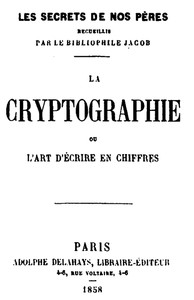
La Cryptographie, ou, l'art d'écrire en chiffres by P. L. Jacob
Read "La Cryptographie, ou, l'art d'écrire en chiffres by P. L. Jacob" Online
This book is available in the public domain. Start reading the digital edition below.
START READING FULL BOOKBook Preview
A short preview of the book’s content is shown below to give you an idea of its style and themes.
Published in 1841, this book is a guided tour through the shadowy world of secret writing. P. L. Jacob, a historian and librarian, acts as your guide, pulling examples from centuries of history to show how codes and ciphers really worked.
The Story
There isn't a single plot, but there is a clear narrative: the endless duel between hiding information and uncovering it. Jacob starts with the basics, explaining different methods like substitution ciphers (where you swap letters) and transposition ciphers (where you scramble their order). He doesn't just describe them; he shows you how they were used. You'll read about Mary, Queen of Scots, whose encrypted letters led to her execution, and about how clever codebrechers in Louis XIV's court unraveled enemy plans. The book moves from simple tricks used in personal letters to the complex systems that decided the fates of nations. It's the story of human ingenuity applied to the fundamental need for privacy and the equally powerful desire to uncover secrets.
Why You Should Read It
What makes this book special is its perspective. This isn't a modern tech textbook. It's history written when cryptography was still primarily about pen, paper, and human cleverness. Reading it, you feel the tangible thrill of the chase. You appreciate how a slight pattern in a letter, or a spy's lucky guess, could change everything. Jacob writes with clear admiration for the 'art' of it all. He makes you see cryptography not just as a tool, but as a fascinating slice of social and political history. It connects dots you might not have considered, showing how secret communication influenced diplomacy, war, and scandal.
Final Verdict
This is a gem for a specific kind of reader. It's perfect for history buffs who enjoy 'behind-the-scenes' stories, or for puzzle lovers curious about the origins of their hobby. It's also great if you're a writer looking for authentic historical detail about espionage. A modern reader should be prepared for its age—the examples stop in the early 1800s, and it's a translation from 19th-century French. But if you can embrace that, it's a captivating look at the original 'cyber' security, proving that the need to protect secrets is a timeless human drama.
This content is free to share and distribute. Access is open to everyone around the world.
Aiden Gonzalez
1 year agoSimply put, the content flows smoothly from one chapter to the next. Thanks for sharing this review.
Elijah Anderson
11 months agoWow.
Barbara Ramirez
1 year agoThe index links actually work, which is rare!
Ethan Nguyen
1 year agoGreat digital experience compared to other versions.


Elizabeth Wilson
1 year agoRead this on my tablet, looks great.