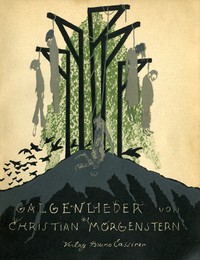
Galgenlieder nebst dem 'Gingganz' by Christian Morgenstern
Read "Galgenlieder nebst dem 'Gingganz' by Christian Morgenstern" Online
This book is available in the public domain. Start reading the digital edition below.
START READING FULL BOOKBook Preview
A short preview of the book’s content is shown below to give you an idea of its style and themes.
Let's be clear from the start: Galgenlieder (which means "Gallows Songs") isn't a novel with a plot you can summarize. It's a collection of short, wildly imaginative poems set in a fictional universe called Gallows Hill. Think of it as a quirky neighborhood where the residents include the dreamy Palmström, his more pragmatic friend Von Korf, and a whole cast of talking animals, sentient objects, and mischievous spirits.
The Story
There's no linear story. Instead, each poem is a tiny, self-contained world. In one, a man named Palmström, convinced nightingales sing by candlelight, tries to furnish them with tiny lanterns. In another, two heel bones have a secret conversation. A moose reads its own biography in a mirror, and a picket fence gets the blues. The poems in the appended section, Gingganz, get even more abstract, playing with pure sound and nonsense words that somehow feel deeply meaningful. The throughline is a spirit of playful rebellion—against strict grammar, boring reality, and the idea that art has to be serious to be important.
Why You Should Read It
I love this book because it's a joy factory for your imagination. Morgenstern doesn't just write about the absurd; he builds a home for it and invites you in. The humor is infectious, but underneath the laughs, there's a sharp commentary on how rigid our thinking can be. Why can't a heel bone have feelings? Who decided a moose shouldn't appreciate art? It makes you question the invisible rules we all live by. Reading it feels like a mental stretch, a reminder that language isn't just a tool for information—it's a playground.
Final Verdict
This book is perfect for anyone who enjoys wordplay, clever humor, and a bit of philosophical weirdness. Fans of Lewis Carroll, Edward Gorey, or even modern absurdists like the John Mulaney & The Sack Lunch Bunch special will find a kindred spirit here. It's also a fantastic pick for poetry skeptics, because it throws all the stuffy conventions out the window. Just be ready to smile, scratch your head, and see the world a little differently afterward.
This historical work is free of copyright protections. It is available for public use and education.
Charles Jackson
2 months agoImpressive quality for a digital edition.
Jennifer Gonzalez
6 months agoVery helpful, thanks.
John Flores
1 year agoNot bad at all.
Mark Hernandez
1 year agoThis is one of those stories where the arguments are well-supported by credible references. A true masterpiece.
Joseph Williams
6 months agoIf you're tired of surface-level information, the author clearly has a deep mastery of the subject matter. This exceeded my expectations in almost every way.