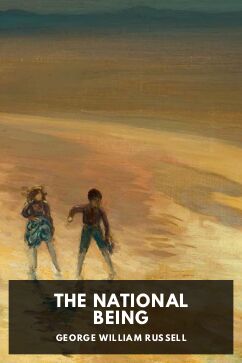
The National Being - George William Russell

(19 User reviews)   3521
By Brenda Hill Posted on Jan 27, 2026
In Category - Bioethics
George William Russell George William Russell
English
Hey, have you ever wondered what makes a nation truly alive? Not just the lines on a map or the government in charge, but its soul? I just finished 'The National Being' by George William Russell, and it's been rattling around in my head ever since. Forget dry political theory—this is a poet's urgent plea for a better Ireland, written right in the thick of the early 20th century. The main tension here isn't between armies, but between two ideas: the old, tired system of competition and exploitation, and Russell's radical vision of a cooperative commonwealth built on shared land, shared industry, and shared spirit. It's the conflict between what a nation is and what it could be if we dared to think differently about community, economics, and our connection to the earth. It’s surprisingly fiery and feels weirdly relevant today.
Share

Read "The National Being - George William Russell" Online

This book is available in the public domain. Start reading the digital edition below.

START READING FULL BOOK
Instant Access    Mobile Friendly

Book Preview

A short preview of the book’s content is shown below to give you an idea of its style and themes.

some old play.’ This story explains the genesis of this book. Like John Gilpin’s wife, it seems that though on pleasure he was bent, he had a frugal mind. He did not forget business. When reading Ben Jonson or Beaumont and Fletcher he had pencil in hand, and whenever he came to a word that might prove a stumbling-block to the general reader, he noted that word, and eventually wrote it on a separate slip (note-paper size) with exact reference and explanation. In July, 1911, in Oxford, when we were together for the last time, the professor told me about the book he was preparing—mainly consisting of the words he had collected in reading the Tudor and Stuart dramatists. He did not intend it to be a big book. When I asked whether it would contain quotations like Nares’ Glossary, he said it would contain only a few quotations, and those short ones, and would consist mostly of explanations and references, with brief etymologies. I heard no more of the book during his lifetime. But frequent letters passed between us on the etymologies of English words, many of which he was meeting with in the material he was collecting. On October 6, 1912, that eager, enthusiastic spirit passed away, to the regret of all who work in the field of English philology, of all who love the English tongue, wherever on this habitable globe they may chance to live. Not long after, in November, I heard from Mrs. Skeat that her husband had left material for a Glossary of Rare Words, in slips amounting to nearly 7,000, arranged in alphabetical order, and that Professor Skeat’s executors would be very glad if I would be able to edit and prepare the work for publication. I agreed to do this, on condition that the executors should ask the advice of a pupil of Dr. Skeat, an eminent English scholar, and also, of course, that the Delegates of the Clarendon Press would consent to the arrangement. On December 4 I received a letter from the Clarendon Press, informing me that the Delegates accepted my offer. A day or two after the box containing the MS. arrived, and on December 9 I addressed myself to the task. With the exception of a short intermission in July, the work has had my continuous and undivided attention for one year. On examination of the MS. it appeared that, although Professor Skeat had arranged the material in the form of a Glossary, he had not put the finishing touches to the book (many slips were practically duplicates or triplicates), and had not even finally limited the scope: the title of the book was not settled. And now it will be proper to state as clearly as possible what the Editor thought it his duty to do in preparing his friend’s work for publication. In the first place he did not think that it fell within his province to make any considerable addition to the Word-list. The Vocabulary remains much as Professor Skeat left it. But it was found necessary, in going over the work, to make additions in many articles, in order to explain the history of the word, or to illustrate its meaning; connecting links had to be supplied, where the meanings of a word apparently had no connexion with one another. In this part of the work the Editor found great help in the New English Dictionary; and it will be seen that there is hardly a page of this book on which there does not occur the significant abbreviation (NED.). With the same help...

This is a limited preview. Download the book to read the full content.

Let's set the scene: It's 1916, Ireland. The Easter Rising has just happened, and the whole country is at a fiery crossroads. Into this moment steps George William Russell (who often wrote as 'Æ'), not with a battle plan, but with a blueprint for a nation's soul. 'The National Being' is his passionate argument for rebuilding Ireland from the ground up, not through more politics-as-usual, but through a complete reimagining of society.

The Story

There isn't a traditional plot with characters. Instead, Russell lays out his vision like an architect. He starts with the land, arguing it should be owned by the people, not landlords. From there, he builds his idea: a network of cooperative farms and industries where people work together, not against each other. He dreams of a national spirit fueled by art, education, and a deep, almost mystical connection to the Irish soil and its history. The 'story' is the journey from a broken, divided present to this potential future of shared prosperity and purpose.

Why You Should Read It

Here's the thing: Russell writes like a prophet and a practical farmer at the same time. His love for Ireland bleeds through every page, but it's a demanding love. He's furious at waste—waste of land, talent, and human potential. Reading this, you get a raw, immediate sense of the hopes and anxieties of that era. But it's not just a history lesson. His core questions—How do we build a fair economy? What does real community look like? What is a nation's responsibility to its people and its land?—echo loudly in our own time of deep social and economic divides. It challenges the very foundations of how we organize our lives together.

Final Verdict

This book isn't for everyone. If you want a light novel, look elsewhere. But if you're a history lover curious about the ideas swirling around Irish independence beyond the gunfire, this is essential. It's perfect for anyone interested in political philosophy, cooperative movements, or economic alternatives. Most of all, it's for the dreamers and the builders—the people who believe a country can be more than its GDP, and who are brave enough to imagine what that 'more' could be. Prepare to be inspired, frustrated, and made to think.


⚖️ No Rights Reserved

There are no legal restrictions on this material. You are welcome to share this with anyone.

Ashley Wilson
2 years ago

This is one of those stories where the narrative structure is incredibly compelling. A true masterpiece.

Matthew Anderson
2 months ago

Surprisingly enough, the narrative structure is incredibly compelling. Highly recommended.

Edward Young
1 year ago

The fonts used are very comfortable for long reading sessions.

Noah Johnson
1 year ago

Good quality content.

5
5 out of 5 (19 User reviews )

Add a Review

Your Rating *
There are no comments for this eBook.
You must log in to post a comment.
Log in


Related eBooks