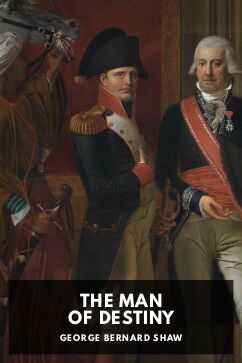
The Man of Destiny - George Bernard Shaw

(3 User reviews)   959
By Brenda Hill Posted on Jan 27, 2026
In Category - Medical Thrillers
George Bernard Shaw George Bernard Shaw
English
Hey, have you ever wondered what Napoleon was like before he became... well, Napoleon? George Bernard Shaw's 'The Man of Destiny' is this brilliant little one-act play that imagines a young, hot-headed Napoleon stuck at a tiny Italian inn. The whole thing kicks off because some important letters have been stolen. The thief? A mysterious and clever lady who arrives at the same inn. What follows is a hilarious and sharp battle of wits. It's not about armies clashing—it's about two incredibly smart people trying to out-talk and out-think each other. Napoleon, who's used to giving orders and having them obeyed, finally meets someone who isn't the least bit intimidated by him. Shaw shows us the man behind the legend, all pride and ambition, being expertly needled and challenged. If you like stories where the real action is in the dialogue, and you enjoy seeing a historical giant taken down a peg with style, you'll love this. It's short, punchy, and surprisingly funny.
Share

Read "The Man of Destiny - George Bernard Shaw" Online

This book is available in the public domain. Start reading the digital edition below.

START READING FULL BOOK
Instant Access    Mobile Friendly

Book Preview

A short preview of the book’s content is shown below to give you an idea of its style and themes.

some old play.’ This story explains the genesis of this book. Like John Gilpin’s wife, it seems that though on pleasure he was bent, he had a frugal mind. He did not forget business. When reading Ben Jonson or Beaumont and Fletcher he had pencil in hand, and whenever he came to a word that might prove a stumbling-block to the general reader, he noted that word, and eventually wrote it on a separate slip (note-paper size) with exact reference and explanation. In July, 1911, in Oxford, when we were together for the last time, the professor told me about the book he was preparing—mainly consisting of the words he had collected in reading the Tudor and Stuart dramatists. He did not intend it to be a big book. When I asked whether it would contain quotations like Nares’ Glossary, he said it would contain only a few quotations, and those short ones, and would consist mostly of explanations and references, with brief etymologies. I heard no more of the book during his lifetime. But frequent letters passed between us on the etymologies of English words, many of which he was meeting with in the material he was collecting. On October 6, 1912, that eager, enthusiastic spirit passed away, to the regret of all who work in the field of English philology, of all who love the English tongue, wherever on this habitable globe they may chance to live. Not long after, in November, I heard from Mrs. Skeat that her husband had left material for a Glossary of Rare Words, in slips amounting to nearly 7,000, arranged in alphabetical order, and that Professor Skeat’s executors would be very glad if I would be able to edit and prepare the work for publication. I agreed to do this, on condition that the executors should ask the advice of a pupil of Dr. Skeat, an eminent English scholar, and also, of course, that the Delegates of the Clarendon Press would consent to the arrangement. On December 4 I received a letter from the Clarendon Press, informing me that the Delegates accepted my offer. A day or two after the box containing the MS. arrived, and on December 9 I addressed myself to the task. With the exception of a short intermission in July, the work has had my continuous and undivided attention for one year. On examination of the MS. it appeared that, although Professor Skeat had arranged the material in the form of a Glossary, he had not put the finishing touches to the book (many slips were practically duplicates or triplicates), and had not even finally limited the scope: the title of the book was not settled. And now it will be proper to state as clearly as possible what the Editor thought it his duty to do in preparing his friend’s work for publication. In the first place he did not think that it fell within his province to make any considerable addition to the Word-list. The Vocabulary remains much as Professor Skeat left it. But it was found necessary, in going over the work, to make additions in many articles, in order to explain the history of the word, or to illustrate its meaning; connecting links had to be supplied, where the meanings of a word apparently had no connexion with one another. In this part of the work the Editor found great help in the New English Dictionary; and it will be seen that there is hardly a page of this book on which there does not occur the significant abbreviation (NED.). With the same help...

This is a limited preview. Download the book to read the full content.

George Bernard Shaw's The Man of Destiny is a one-act play that packs a surprising punch. It's not a grand war epic, but a clever, intimate character study set in 1796. We find a young General Napoleon Bonaparte, years before he crowns himself emperor, stranded at a quiet inn in Tavazzano, Italy. His mood is foul. A packet of letters—potentially damaging to his reputation and career—has been stolen by a courier. Napoleon is furious, trapped, and waiting for the culprit to be caught.

The Story

The plot turns on a razor's edge with the arrival of a 'Strange Lady.' She's charming, poised, and immediately locks horns with Napoleon. It turns out she has the stolen letters. What unfolds is a masterclass in verbal fencing. She doesn't cower before the famous general; she matches his arrogance with her own cool intelligence. They bargain, they bluff, and they dissect each other's motives. A local lieutenant, Giuseppi, gets caught in the middle, and Napoleon's own aide is more of a weary observer. The entire drama happens in the confined space of the inn's courtyard, making the clash of personalities feel even more intense and personal.

Why You Should Read It

I loved this play because it strips away the myth. Shaw gives us a Napoleon who is petulant, boastful, and brilliantly strategic, but also vulnerable to a good verbal trap. The Strange Lady is fantastic—a Shavian heroine who uses her wit as her primary weapon. Their duel isn't fought with swords but with ideas about power, honesty, and destiny. Shaw's dialogue is, as always, sparkling and full of pointed humor. You get the sense he's enjoying poking fun at the idea of the 'Great Man' of history, showing how much of that greatness depends on not being outsmarted by the right person at the right time.

Final Verdict

This is a perfect pick for anyone who enjoys historical fiction with a sharp, modern edge. It's great for theater fans, as you can easily imagine the scenes playing out on stage. If you're intimidated by Shaw's longer works, this is a wonderful, accessible entry point. Perfect for readers who love clever dialogue, strong female characters, and seeing iconic figures brought down to a human scale. You can read it in one sitting, but you'll think about the battle of wits long after.


⚖️ Legacy Content

This digital edition is based on a public domain text. Distribute this work to help spread literacy.

Kenneth Harris
1 year ago

Honestly, the flow of the text seems very fluid. Truly inspiring.

Jessica Thompson
9 months ago

Amazing book.

Mark Moore
2 months ago

Very helpful, thanks.

4.5
4.5 out of 5 (3 User reviews )

Add a Review

Your Rating *
There are no comments for this eBook.
You must log in to post a comment.
Log in


Related eBooks