
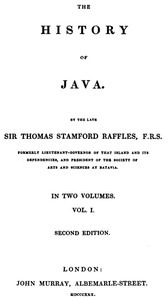
The History of Java, v. 1-2 by Sir Thomas Stamford Raffles
Read "The History of Java, v. 1-2 by Sir Thomas Stamford Raffles" Online
This book is available in the public domain. Start reading the digital edition below.
START READING FULL BOOKBook Preview
A short preview of the book’s content is shown below to give you an idea of its style and themes.
Okay, let's be clear: this is not a beach read. Sir Thomas Stamford Raffles's The History of Java is a monumental, two-volume work published in 1817. Raffles wasn't just a tourist; he was the British Lieutenant-Governor of Java during a brief period of British rule from 1811 to 1816. The book is his attempt to capture everything about the island—its ancient temples, its royal lineages, its plants and animals, its customs, and its languages. He had teams of people helping him research and illustrate it. The result is part travelogue, part encyclopedia, and part colonial report.
Why You Should Read It
Reading this today is a strange experience. On one hand, you have to admire the sheer effort. Raffles genuinely seemed fascinated by Javanese culture. The illustrations of wayang puppets, temple ruins (like Borobudur), and everyday life are incredible. He preserved knowledge that might have otherwise been lost. But on the other hand, you're constantly aware that this is the view from the governor's mansion. He's studying a society he was tasked with administering. His descriptions, while often respectful, are framed by his belief in European progress and the benefits of British rule. The book is a product of its time—both brilliant and blind.
Final Verdict
This is for the curious reader who loves primary sources. It's perfect for history buffs interested in Southeast Asia, colonialism, or the history of museums and collecting. It's also great for anyone who likes to see how knowledge and power were intertwined in the 19th century. Don't read it for a simple narrative; read it to spend time inside the mind of a complex historical figure. You'll come away with a deeper, more nuanced understanding of Java, and a lot to think about.
This publication is available for unrestricted use. You do not need permission to reproduce this work.
Matthew Davis
1 year agoI particularly value the technical accuracy maintained throughout.
Paul Lee
1 year agoHaving followed this topic for years, I can say that the author doesn't just scratch the surface but goes into meaningful detail. A refreshing and intellectually stimulating read.
Jennifer Thomas
1 year agoHaving explored several resources on this, I find that the nuanced approach to the central theme was better than I expected. I'll be citing this in my upcoming project.
Jessica Williams
2 years agoThe citations provided are a goldmine for further academic study.







David Davis
7 months agoComparing this to other titles in the same genre, the author clearly has a deep mastery of the subject matter. If you want to master this topic, start right here.