
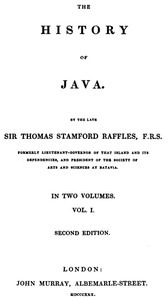
The History of Java, v. 1-2 by Sir Thomas Stamford Raffles

(30 User reviews)   8287
By Brenda Hill Posted on Dec 21, 2025
In Category - Bioethics
Raffles, Thomas Stamford, Sir, 1781-1826 Raffles, Thomas Stamford, Sir, 1781-1826
English
Ever wondered what colonial officials really thought about the places they ruled? Sir Stamford Raffles, the man who founded Singapore, spent years in Java and wrote this massive two-volume love letter to the island. But here's the twist: it's written by the British guy who took it over from the Dutch. This isn't just a dry history—it's a window into how a powerful man saw a culture he was simultaneously documenting, admiring, and controlling. The book is beautiful, detailed, and full of stunning illustrations, but you can't help reading between the lines. It’s the ultimate mixed bag: a groundbreaking record of Javanese art, language, and history, filtered through the lens of colonial ambition. It’s fascinating, problematic, and absolutely essential for understanding the era.
Share

Read "The History of Java, v. 1-2 by Sir Thomas Stamford Raffles" Online

This book is available in the public domain. Start reading the digital edition below.

START READING FULL BOOK
Instant Access    Mobile Friendly

Book Preview

A short preview of the book’s content is shown below to give you an idea of its style and themes.

I represented, and by doing every thing in my power to make them happy. * * * * * To those who judge that the right to express their sentiments requires no more than sincerity, or that their praise is of a value to overbalance the disrespect of offering it, I shall leave the usual language of dedications. Conscious that the assurances of respect and of loyal attachment can never be offered to your Royal Highness by the humblest British subject, without meeting a gracious reception, I have the honour to be, With profound veneration and respect, SIR, YOUR ROYAL HIGHNESS'S Most faithful and most dutiful servant, THOMAS STAMFORD RAFFLES. _London, June 1, 1817._ PREFACE As it is possible that, in the many severe strictures passed, in the course of this work, upon the Dutch Administration in Java, some of the observations may, for want of a careful restriction in the words employed, appear to extend to the Dutch nation and character generally, I think it proper explicitly to declare, that such observations are intended exclusively to apply to the Colonial Government and its Officers. The orders of the Dutch Government in Holland to the Authorities at Batavia, as far as my information extends, breathe a spirit of liberality and benevolence; and I have reason to believe, that the tyranny and rapacity of its colonial officers, created no less indignation in Holland than in other countries of Europe. For such, and all other inaccuracies, as well as for the defects of style and arrangement which may appear in this work, an apology is necessary; and in the circumstances under which it has been prepared, it is hoped that an admissible one will be found. While in the active discharge of the severe and responsible duties of an extensive government, it was not in my power to devote much time to the subject: the most that I could do, was to encourage the exertions of others, and to collect in a crude state such new or interesting matter as fell under my personal observation. I quitted Java in the month of March in last year: in the twelve months that have since elapsed, illness during the voyage to Europe and subsequently, added to the demands on my time arising out of my late office, and the duties of private friendship after an absence of many years, have made great encroachments; but engaged as I am in public life, and about to proceed to a distant quarter of the globe, I have been induced, by the interest which the subject of these volumes has excited, and the precarious state of my health, rather to rely on the indulgence of the public than on the attainment of leisure, for which I must wait certainly long and, possibly, in vain. Most sincerely and deeply do I regret, that this task did not fall into hands more able to do it justice. There was one[1], dear to me in private friendship and esteem, who, had he lived, was of all men best calculated to have supplied those deficiencies which will be apparent in the very imperfect work now presented to the Public. From his profound acquaintance with eastern languages and Indian history, from the unceasing activity of his great talents, his other prodigious acquirements, his extensive views, and his confident hope of illustrating national migrations from the scenes which he was approaching, much might have been expected; but just as he reached those shores on which he hoped to slake his ardent thirst for knowledge, he fell a victim to excessive exertion, deeply deplored by...

This is a limited preview. Download the book to read the full content.

Okay, let's be clear: this is not a beach read. Sir Thomas Stamford Raffles's The History of Java is a monumental, two-volume work published in 1817. Raffles wasn't just a tourist; he was the British Lieutenant-Governor of Java during a brief period of British rule from 1811 to 1816. The book is his attempt to capture everything about the island—its ancient temples, its royal lineages, its plants and animals, its customs, and its languages. He had teams of people helping him research and illustrate it. The result is part travelogue, part encyclopedia, and part colonial report.

Why You Should Read It

Reading this today is a strange experience. On one hand, you have to admire the sheer effort. Raffles genuinely seemed fascinated by Javanese culture. The illustrations of wayang puppets, temple ruins (like Borobudur), and everyday life are incredible. He preserved knowledge that might have otherwise been lost. But on the other hand, you're constantly aware that this is the view from the governor's mansion. He's studying a society he was tasked with administering. His descriptions, while often respectful, are framed by his belief in European progress and the benefits of British rule. The book is a product of its time—both brilliant and blind.

Final Verdict

This is for the curious reader who loves primary sources. It's perfect for history buffs interested in Southeast Asia, colonialism, or the history of museums and collecting. It's also great for anyone who likes to see how knowledge and power were intertwined in the 19th century. Don't read it for a simple narrative; read it to spend time inside the mind of a complex historical figure. You'll come away with a deeper, more nuanced understanding of Java, and a lot to think about.


📚 Public Domain Notice

This publication is available for unrestricted use. You do not need permission to reproduce this work.

Thomas Johnson
5 months ago

Loved it.

Joshua Harris
1 year ago

Used this for my thesis, incredibly useful.

Matthew Hill
1 year ago

Enjoyed every page.

Karen Thompson
8 months ago

I was skeptical at first, but the pacing is just right, keeping you engaged. I will read more from this author.

David Ramirez
9 months ago

This is one of those stories where the arguments are well-supported by credible references. A valuable addition to my collection.

5
5 out of 5 (30 User reviews )

Add a Review

Your Rating *
There are no comments for this eBook.
You must log in to post a comment.
Log in


Related eBooks