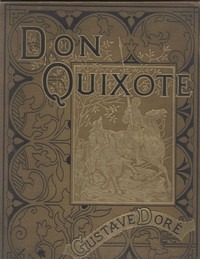
The History of Don Quixote, Volume 1, Complete by Miguel de Cervantes Saavedra

(21 User reviews)   7304
By Brenda Hill Posted on Dec 21, 2025
In Category - Medical Research
Cervantes Saavedra, Miguel de, 1547-1616 Cervantes Saavedra, Miguel de, 1547-1616
English
Ever met someone so obsessed with stories that they lose touch with reality? Meet Alonso Quixano, a country gentleman who has read so many chivalric romances that he decides to become a knight-errant himself. Renaming himself Don Quixote, he dons a rusty suit of armor, mounts his scrawny horse Rocinante, and recruits a simple farmer, Sancho Panza, as his squire. The real conflict isn't with dragons or evil knights—it's between his glorious, book-fueled imagination and the very mundane, stubborn world around him. Windmills become giants, inns become castles, and every adventure is a hilarious, heartbreaking collision of idealism and reality. It's about the power and peril of stories, and it's way funnier than a 400-year-old book has any right to be.
Share

Read "The History of Don Quixote, Volume 1, Complete by Miguel de Cervantes Saavedra" Online

This book is available in the public domain. Start reading the digital edition below.

START READING FULL BOOK
Instant Access    Mobile Friendly

Book Preview

A short preview of the book’s content is shown below to give you an idea of its style and themes.

The history of our English translations of “Don Quixote” is instructive. Shelton’s, the first in any language, was made, apparently, about 1608, but not published till 1612. This of course was only the First Part. It has been asserted that the Second, published in 1620, is not the work of Shelton, but there is nothing to support the assertion save the fact that it has less spirit, less of what we generally understand by “go,” about it than the first, which would be only natural if the first were the work of a young man writing currente calamo, and the second that of a middle-aged man writing for a bookseller. On the other hand, it is closer and more literal, the style is the same, the very same translations, or mistranslations, occur in it, and it is extremely unlikely that a new translator would, by suppressing his name, have allowed Shelton to carry off the credit. In 1687 John Phillips, Milton’s nephew, produced a “Don Quixote” “made English,” he says, “according to the humour of our modern language.” His “Quixote” is not so much a translation as a travesty, and a travesty that for coarseness, vulgarity, and buffoonery is almost unexampled even in the literature of that day. Ned Ward’s “Life and Notable Adventures of Don Quixote, merrily translated into Hudibrastic Verse” (1700), can scarcely be reckoned a translation, but it serves to show the light in which “Don Quixote” was regarded at the time. A further illustration may be found in the version published in 1712 by Peter Motteux, who had then recently combined tea-dealing with literature. It is described as “translated from the original by several hands,” but if so all Spanish flavour has entirely evaporated under the manipulation of the several hands. The flavour that it has, on the other hand, is distinctly Franco-cockney. Anyone who compares it carefully with the original will have little doubt that it is a concoction from Shelton and the French of Filleau de Saint Martin, eked out by borrowings from Phillips, whose mode of treatment it adopts. It is, to be sure, more decent and decorous, but it treats “Don Quixote” in the same fashion as a comic book that cannot be made too comic. To attempt to improve the humour of “Don Quixote” by an infusion of cockney flippancy and facetiousness, as Motteux’s operators did, is not merely an impertinence like larding a sirloin of prize beef, but an absolute falsification of the spirit of the book, and it is a proof of the uncritical way in which “Don Quixote” is generally read that this worse than worthless translation--worthless as failing to represent, worse than worthless as misrepresenting--should have been favoured as it has been. It had the effect, however, of bringing out a translation undertaken and executed in a very different spirit, that of Charles Jervas, the portrait painter, and friend of Pope, Swift, Arbuthnot, and Gay. Jervas has been allowed little credit for his work, indeed it may be said none, for it is known to the world in general as Jarvis’s. It was not published until after his death, and the printers gave the name according to the current pronunciation of the day. It has been the most freely used and the most freely abused of all the translations. It has seen far more editions than any other, it is admitted on all hands to be by far the most faithful, and yet nobody seems to have a good word to say for it or for its author. Jervas no doubt prejudiced readers against himself in his...

This is a limited preview. Download the book to read the full content.

Let's be honest: the idea of tackling a classic like Don Quixote can feel like homework. But trust me, this book is a riot. It’s not a dusty relic; it’s a living, breathing story that’s survived for centuries because it’s genuinely entertaining.

The Story

Alonso Quixano has read one too many books about knights and decides to become one. He calls himself Don Quixote de la Mancha, puts on some old armor, and sets out to right the world's wrongs. He’s joined by Sancho Panza, a practical farmer who hopes to get rich from this mad venture. The plot follows their misadventures as Quixote’s mind transforms the ordinary Spanish countryside into a stage for epic quests. He famously attacks windmills he believes are giants, tries to free prisoners he thinks are oppressed nobles, and dedicates his deeds to a peasant woman he imagines as a noble lady. The heart of the story is the constant, comedic gap between Quixote’s grand vision and the plain truth Sancho sees.

Why You Should Read It

This book is so much more than its famous windmill scene. At its core, it’s a deep and surprisingly moving friendship story. Sancho, for all his eye-rolling and desire for an island to govern, slowly becomes devoted to his mad master. Their conversations are brilliant—Quixote speaks in flowery, old-fashioned ideals, and Sancho answers with proverbs and down-to-earth wisdom. It makes you wonder: who is really wiser? The man who sees a better world, or the man who sees the world as it is? It’s a book about loyalty, the madness of obsession, and the incredible power of stories to shape our lives, for better and worse.

Final Verdict

Perfect for anyone who loves a great character duo, smart humor, and stories that make you think while you laugh. If you enjoy buddy comedies or tales about dreamers battling a cynical world, you’ll find a kindred spirit in Don Quixote. Don’t be intimidated by its age or reputation; just jump in and meet one of literature’s most unforgettable pairs. You’ll be rooting for them by the end of the first chapter.


🟢 Community Domain

You are viewing a work that belongs to the global public domain. It is now common property for all to enjoy.

Dorothy Lewis
5 months ago

Good quality content.

Carol Moore
7 months ago

I have to admit, the depth of research presented here is truly commendable. I will read more from this author.

Patricia Wright
1 year ago

Simply put, the emotional weight of the story is balanced perfectly. A valuable addition to my collection.

Lisa Harris
1 year ago

After finishing this book, the emotional weight of the story is balanced perfectly. Thanks for sharing this review.

Emily Thompson
1 year ago

I didn't expect much, but the pacing is just right, keeping you engaged. Don't hesitate to start reading.

5
5 out of 5 (21 User reviews )

Add a Review

Your Rating *
There are no comments for this eBook.
You must log in to post a comment.
Log in


Related eBooks