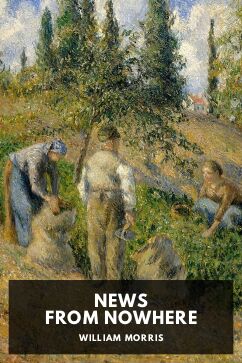
News from Nowhere - William Morris

(14 User reviews)   3260
By Brenda Hill Posted on Jan 27, 2026
In Category - Medical Research
William Morris William Morris
English
Ever have one of those nights where you go to bed wishing the world was better, only to wake up in a future that actually fixed everything? That's exactly what happens to William Guest in William Morris's 1890 novel 'News from Nowhere.' He falls asleep in grimy, industrial London and wakes up along the Thames in a 22nd-century England that looks like a medieval dream. There are no factories, no money, no prisons, and everyone seems genuinely happy doing beautiful, useful work. The central mystery isn't a whodunit—it's a 'how-dunit.' How did this society come to be? What happened to all the greed and conflict we think is human nature? As Guest explores this lush, handmade world, he's constantly trying to piece together the quiet revolution that made it possible. It's less of a traditional adventure and more of a gentle, hypnotic tour of a utopia that feels both impossibly distant and deeply desirable. If you've ever felt exhausted by modern life and longed for a simpler, kinder world, this book is like a cool drink of water for your soul.
Share

Read "News from Nowhere - William Morris" Online

This book is available in the public domain. Start reading the digital edition below.

START READING FULL BOOK
Instant Access    Mobile Friendly

Book Preview

A short preview of the book’s content is shown below to give you an idea of its style and themes.

some old play.’ This story explains the genesis of this book. Like John Gilpin’s wife, it seems that though on pleasure he was bent, he had a frugal mind. He did not forget business. When reading Ben Jonson or Beaumont and Fletcher he had pencil in hand, and whenever he came to a word that might prove a stumbling-block to the general reader, he noted that word, and eventually wrote it on a separate slip (note-paper size) with exact reference and explanation. In July, 1911, in Oxford, when we were together for the last time, the professor told me about the book he was preparing—mainly consisting of the words he had collected in reading the Tudor and Stuart dramatists. He did not intend it to be a big book. When I asked whether it would contain quotations like Nares’ Glossary, he said it would contain only a few quotations, and those short ones, and would consist mostly of explanations and references, with brief etymologies. I heard no more of the book during his lifetime. But frequent letters passed between us on the etymologies of English words, many of which he was meeting with in the material he was collecting. On October 6, 1912, that eager, enthusiastic spirit passed away, to the regret of all who work in the field of English philology, of all who love the English tongue, wherever on this habitable globe they may chance to live. Not long after, in November, I heard from Mrs. Skeat that her husband had left material for a Glossary of Rare Words, in slips amounting to nearly 7,000, arranged in alphabetical order, and that Professor Skeat’s executors would be very glad if I would be able to edit and prepare the work for publication. I agreed to do this, on condition that the executors should ask the advice of a pupil of Dr. Skeat, an eminent English scholar, and also, of course, that the Delegates of the Clarendon Press would consent to the arrangement. On December 4 I received a letter from the Clarendon Press, informing me that the Delegates accepted my offer. A day or two after the box containing the MS. arrived, and on December 9 I addressed myself to the task. With the exception of a short intermission in July, the work has had my continuous and undivided attention for one year. On examination of the MS. it appeared that, although Professor Skeat had arranged the material in the form of a Glossary, he had not put the finishing touches to the book (many slips were practically duplicates or triplicates), and had not even finally limited the scope: the title of the book was not settled. And now it will be proper to state as clearly as possible what the Editor thought it his duty to do in preparing his friend’s work for publication. In the first place he did not think that it fell within his province to make any considerable addition to the Word-list. The Vocabulary remains much as Professor Skeat left it. But it was found necessary, in going over the work, to make additions in many articles, in order to explain the history of the word, or to illustrate its meaning; connecting links had to be supplied, where the meanings of a word apparently had no connexion with one another. In this part of the work the Editor found great help in the New English Dictionary; and it will be seen that there is hardly a page of this book on which there does not occur the significant abbreviation (NED.). With the same help...

This is a limited preview. Download the book to read the full content.

William Morris, better known for his stunning wallpaper and textile designs, wrote this book as his answer to the cold, mechanical futures being imagined in his time. It's a personal and poetic blueprint for a better world.

The Story

The story follows William Guest (a stand-in for Morris himself). After a frustrating political meeting, he goes home to Victorian London, a place choked by smoke and inequality. He wakes up to find himself in the same geographical location, but centuries in the future. The River Thames is clear, London is a series of beautiful villages, and great buildings like the Houses of Parliament are used as storage sheds for manure—a pretty clear opinion on politics!

Guest is guided by a man named Dick Hammond and his wife Clara. They take him on a journey up the Thames by boat, showing him a society that has abolished private property, money, and the class system. People work because they find joy in creating useful and beautiful things, from forging iron to making bread. There's no central government, no crime, and the environment has healed. The entire plot is Guest asking, 'But how does this *work*?' and the locals explaining their history of a peaceful, grassroots change they simply call 'The Revolution.'

Why You Should Read It

This isn't a book with a fast plot or deep character drama. It's a mood. Reading it feels like taking a long, slow walk through a perfect summer meadow. The joy is in the details: the description of a hand-carved wooden cup, the pleasure of a good day's rowing, the satisfaction of a communal meal. Morris uses his artist's eye to paint every scene.

What struck me most is its radical kindness. Morris's utopia isn't built on advanced technology, but on advanced human relationships. It argues that beauty, craft, and community are not luxuries, but the essential foundations for a good life. In our age of burnout, algorithmic anxiety, and disposable goods, this 130-year-old vision feels incredibly fresh and desperately needed.

Final Verdict

Perfect for dreamers, artists, and anyone who feels a deep unease with our hyper-industrial, profit-driven world. If you love the detailed world-building of fantasy novels but wish it was applied to a hopeful human future, you'll find a lot to love here. Fair warning: if you need a book driven by conflict and cliffhangers, this might feel too slow. But if you're in the mood for a profound, peaceful, and beautifully written 'what if,' News from Nowhere is a unique and comforting classic. It's less a story and more an invitation to imagine better.


🏛️ Usage Rights

You are viewing a work that belongs to the global public domain. Distribute this work to help spread literacy.

Ava Moore
1 year ago

I was skeptical at first, but the storytelling feels authentic and emotionally grounded. I learned so much from this.

Joshua King
10 months ago

Recommended.

Liam Allen
1 year ago

From the very first page, it provides a comprehensive overview perfect for everyone. Highly recommended.

James Garcia
7 months ago

Finally found time to read this!

Edward Perez
3 months ago

A must-have for anyone studying this subject.

4.5
4.5 out of 5 (14 User reviews )

Add a Review

Your Rating *
There are no comments for this eBook.
You must log in to post a comment.
Log in


Related eBooks