
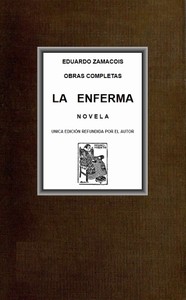
La enferma: novela by Eduardo Zamacois
Read "La enferma: novela by Eduardo Zamacois" Online
This book is available in the public domain. Start reading the digital edition below.
START READING FULL BOOKBook Preview
A short preview of the book’s content is shown below to give you an idea of its style and themes.
I picked up Eduardo Zamacois's La enferma (The Sick Woman) expecting a period piece, but what I found was a tense, character-driven puzzle that refused to let me go. Published in 1895, it feels far more contemporary in its concerns than its publication date suggests.
The Story
The plot revolves around Blanca, a young woman from a well-off family who suffers from a strange, debilitating illness that no doctor can diagnose. Her life is confined to her room, and her world consists of her devoted but weary family and her frustrated fiancé, Ricardo. Enter Dr. Rojas, a brilliant and ambitious physician determined to crack the case. As he spends more time with Blanca, he becomes entangled in her world. He sees flashes of strength and willpower that don't match the image of the helpless invalid. The central conflict isn't a physical battle against disease, but a psychological duel. Is Blanca's illness a tragic physical reality, or is it an elaborate, possibly unconscious, performance—a way to control her environment and the people in it? The uncertainty infects everyone in the house, turning care into suspicion and love into doubt.
Why You Should Read It
What grabbed me wasn't the medical mystery, but the human one. Zamacois is brilliant at building atmosphere. The house feels like a gilded cage, and the tension comes from the quiet moments—a glance held too long, a sigh that seems practiced. You're never quite sure if Blanca is the ultimate victim or a cunning puppeteer. This ambiguity makes her fascinating. It also forces you to question how we perceive illness, especially in women, and how easily care can become a form of control. The doctor's own obsession is a story in itself. Is he a healer, or just another man trying to solve and possess the enigmatic woman in front of him? It's a short book, but it packs a lot of uncomfortable questions.
Final Verdict
This book is perfect for readers who love classic literature but crave psychological depth and moral ambiguity. If you enjoyed the tense, confined feel of novels like The Turn of the Screw or the complex character studies of later writers, you'll find a lot to love here. It's not a fast-paced adventure; it's a slow, careful excavation of truth and deception. I'd recommend it to anyone interested in the history of medicine, gender roles, or stories that trust the reader to sit with uncertainty. Just be prepared to have your own diagnosis of Blanca change chapter by chapter.
This historical work is free of copyright protections. Thank you for supporting open literature.
Sarah Jackson
6 months agoI appreciate the objective tone and the evidence-based approach.
Nancy Jackson
3 months agoAs a long-time follower of this subject matter, the level of detail in the second half of the book is truly impressive. Thanks for making such a high-quality version available.
Karen Garcia
11 months agoI've been looking for a reliable source on this topic, and the visual layout and supporting data make the reading experience very smooth. A mandatory read for anyone in this industry.
Edward Thompson
1 year agoSolid story.





Margaret Lopez
8 months agoThe author provides a very nuanced critique of current methodologies.