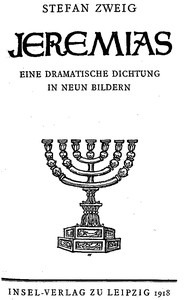
Jeremias: Eine dramatische Dichtung in neun Bildern by Stefan Zweig

(18 User reviews)   5826
By Brenda Hill Posted on Dec 21, 2025
In Category - Medical Thrillers
Zweig, Stefan, 1881-1942 Zweig, Stefan, 1881-1942
German
Ever wondered what it feels like to be the only person who sees disaster coming? Stefan Zweig's 'Jeremias' takes you inside the mind of a prophet who knows his city is doomed, but no one will listen. Written during the chaos of World War I, it's not just a biblical retelling—it's a raw, personal scream into the void about the loneliness of truth-tellers. If you've ever felt ignored or helpless in the face of collective madness, this play will hit you right in the gut. It’s short, powerful, and feels terrifyingly relevant.
Share

Read "Jeremias: Eine dramatische Dichtung in neun Bildern by Stefan Zweig" Online

This book is available in the public domain. Start reading the digital edition below.

START READING FULL BOOK
Instant Access    Mobile Friendly

Book Preview

A short preview of the book’s content is shown below to give you an idea of its style and themes.

Im Original sind die Bühnedirektionen im Kleinschrift gesetzt. Schreibweise und Interpunktion des Originaltextes wurden übernommen; lediglich offensichtliche Druckfehler wurden korrigiert. Eine Liste der vorgenommenen Änderungen findet sich am Ende des Textes. Kursiver Text wurde _so_ markiert Fett gedruckter Text wurde =so= markiert [Illustration] STEFAN ZWEIG =JEREMIAS= EINE DRAMATISCHE DICHTUNG IN NEUN BILDERN [Illustration] INSEL-VERLAG ZU LEIPZIG 1918 FRIEDERIKE MARIA VON WINTERNITZ DANKBARST OSTERN 1915 -- OSTERN 1917 DIE BILDER DES GEDICHTS I. Die Erweckung des Profeten 11 II. Die Warnung 25 III. Das Gerücht 51 IV. Die Wachen auf dem Walle 67 V. Die Prüfung des Profeten 91 VI. Stimmen um Mitternacht 113 VII. Die letzte Not 147 VIII. Die Umkehr 163 IX. Der ewige Weg 193 DIE GESTALTEN DES GEDICHTS ZEDEKIA, der König PASHUR, der Hohepriester NACHUM, der Verwalter IMRE, der Älteste der Bürger ABIMELECH, der Oberste der Kriegsknechte HANANJA, der Profet des Volkes Schwertträger, Krieger, Knechte * * * * * JEREMIAS SEINE MUTTER JOCHEBED, eine Anverwandte ACHAB, der Diener BARUCH, ein Jüngling SEBULON, sein Vater * * * * * DAS VOLK VON JERUSALEM DIE GESANDTEN NABUKADNEZARS CHALDÄISCHE UND ÄGYPTISCHE KRIEGER * * * * * Der Schauplatz des Gedichts ist Jerusalem zur Zeit seines Untergangs. DAS ERSTE BILD DIE ERWECKUNG DES PROFETEN »Rufe mir, so will ich dir antworten und dir anzeigen große und gewaltige Dinge, die du nicht weißt.« Jer. XXX, 3. Das flache Dach auf dem Hause des Jeremias, weißgequadert und blinkend im matten Mond. In der Tiefe mit Türmen und Zinnen, mit Schlaf und Stille Jerusalem. Alles ist reglos ringsum, nur der Wind der ersten Frühe fährt manchmal tönend durch das Schweigen. Plötzlich Schritte, polternd und hastig, die Treppe empor. Jeremias im losen Kleid, die Brust offen, wie ein Gewürgter keuchend, stürmt herauf. JEREMIAS: Die Tore rammelt zu ... die Riegel vor ... zum Wall ... zum Walle!... Oh Wächter, schlimme Wächter ... sie kommen ... sie sind da ... Brand über uns ... im Tempel Brand ... Hilfe ... zu Hilfe!... Die Mauer fällt, die Mauer ... JEREMIAS (ist bis zum Rande des Daches vorgestürmt und hält plötzlich inne. Sein Schrei prallt gell gegen die weiße Stille. Er schrickt zusammen, ein Erwachen kommt über ihn. Sein Blick tastet wie der eines Trunkenen über die Stadt hin, seine Arme, die schreckhaft gespreizten, brechen langsam nieder, müde streift die Hand über die offenen Lider): Wahn! Wieder Trug und Traum, der fürchterliche! Oh Träume, Träume, Träume, wie voll ist ihrer das Haus! (Er beugt sich über den Rand der Mauer und blickt hinab:) Friedlich die Stadt, friedlich das Land, in mir nur dieser Brand, nur meine Brust ein Feuer! Oh, wie sie selig ruht in Gottes Arm, von Schlaf bebrütet, überdacht von Frieden, ein Tau von Mond auf jedem Haus und Schlummer, sachter Schlummer auf jedes Hauses Stirn. Nur ich, ich brenne Nacht um Nacht, stürz hin mit allen Türmen, fliehe Flucht, vergeh in Flammen, nur ich, nur ich, zerwühlt die Eingeweide, fahr taumelnd hoch vom heißen Bett zum Mond, daß er mich kühle! Nur mir sprengt Traum den Schlaf, nur mir frißt feurig Graun das Schwarze von den Lidern! Oh Marter dieses Bilds, oh Irrwitz von Gesichten, die trügerisch im Blut sich ballen und matt schmelzen dann im wachen Mond! Und immer gleich der Traum, gleich dieser Wahn, Nacht, Nacht und Nacht, der gleiche Schrecken sich im Fleische bäumend, der gleiche Traum zu gleicher Qual entbrennend! Wer tat dies in mein Blut, dies Gift der Träume, wer, wer jagt mich so mit Schrecknis? Wer hungert meines Schlafs, daß er ihn wegfrißt mir vom Leibe, wer quält, wer quälet mich? Mond, Nacht, Gestirn, ihr kalten...

This is a limited preview. Download the book to read the full content.

Stefan Zweig wrote 'Jeremias' in 1917, right in the middle of the First World War. He was horrified by the conflict, and this play became his way of shouting into the silence. It reimagines the story of the prophet Jeremiah, who is chosen by God to warn Jerusalem of its impending destruction by the Babylonians.

The Story

The play follows Jeremiah as he delivers his grim warnings. He's not a triumphant hero, but a broken, reluctant man. The king, the priests, and the people all reject him. They call him a traitor and a madman, preferring their blind patriotism and false hope. We watch as Jeremiah battles doubt, loneliness, and the crushing weight of being right when everyone else is wrong. The city marches, cheerfully and foolishly, toward its own ruin.

Why You Should Read It

This isn't a dry history lesson. Zweig makes you feel Jeremiah's anguish. You understand his frustration as clear logic is drowned out by nationalistic fervor. The real tension isn't about whether the city falls—we know it will. It's about watching a good man struggle to hold onto his integrity and compassion in a world that has lost its mind. It’s a play about moral courage when courage seems pointless.

Final Verdict

Perfect for anyone who loves psychological depth in historical settings. If you're interested in the human cost of war, the psychology of crowds, or stories about stubborn hope, this is for you. It’s a quick but heavy read, best suited for when you're ready to sit with a powerful, uncomfortable idea. A stunning, personal work from one of the 20th century's great humanists.


📚 Copyright Free

This text is dedicated to the public domain. Knowledge should be free and accessible.

Noah Brown
1 year ago

I started reading out of curiosity and the clarity of the writing makes this accessible. Don't hesitate to start reading.

Steven Lewis
7 months ago

Without a doubt, the emotional weight of the story is balanced perfectly. Worth every second.

Aiden Sanchez
1 month ago

I was skeptical at first, but the pacing is just right, keeping you engaged. Exceeded all my expectations.

Joshua Anderson
1 year ago

Comprehensive and well-researched.

John Ramirez
11 months ago

Simply put, it challenges the reader's perspective in an intellectual way. I learned so much from this.

5
5 out of 5 (18 User reviews )

Add a Review

Your Rating *
There are no comments for this eBook.
You must log in to post a comment.
Log in


Related eBooks