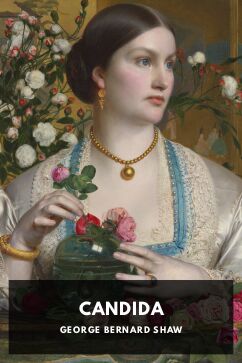
Candida - George Bernard Shaw

(19 User reviews)   3649
By Brenda Hill Posted on Jan 27, 2026
In Category - Medical Thrillers
George Bernard Shaw George Bernard Shaw
English
Okay, picture this: a perfect Victorian home, a charming, respected husband, and a beautiful, intelligent wife. Everything seems ideal. Then, a young, starving poet shows up at the door. He's passionate, reckless, and declares he's in love with the wife. The real kicker? He thinks he's there to rescue her from her dull, comfortable life. But what if she doesn't want to be rescued? That's the brilliant setup of George Bernard Shaw's 'Candida.' It's not a steamy love triangle—it's a sharp, witty debate about what love and marriage really mean. Who needs saving more: the wife from her boring husband, or the husband from his own smugness? The wife, Candida, holds all the cards, and watching her navigate these two very different men is an absolute delight. Shaw makes you laugh while making you think hard about who has the real power in a relationship. Forget what you think you know about Victorian dramas; this one turns everything on its head.
Share

Read "Candida - George Bernard Shaw" Online

This book is available in the public domain. Start reading the digital edition below.

START READING FULL BOOK
Instant Access    Mobile Friendly

Book Preview

A short preview of the book’s content is shown below to give you an idea of its style and themes.

some old play.’ This story explains the genesis of this book. Like John Gilpin’s wife, it seems that though on pleasure he was bent, he had a frugal mind. He did not forget business. When reading Ben Jonson or Beaumont and Fletcher he had pencil in hand, and whenever he came to a word that might prove a stumbling-block to the general reader, he noted that word, and eventually wrote it on a separate slip (note-paper size) with exact reference and explanation. In July, 1911, in Oxford, when we were together for the last time, the professor told me about the book he was preparing—mainly consisting of the words he had collected in reading the Tudor and Stuart dramatists. He did not intend it to be a big book. When I asked whether it would contain quotations like Nares’ Glossary, he said it would contain only a few quotations, and those short ones, and would consist mostly of explanations and references, with brief etymologies. I heard no more of the book during his lifetime. But frequent letters passed between us on the etymologies of English words, many of which he was meeting with in the material he was collecting. On October 6, 1912, that eager, enthusiastic spirit passed away, to the regret of all who work in the field of English philology, of all who love the English tongue, wherever on this habitable globe they may chance to live. Not long after, in November, I heard from Mrs. Skeat that her husband had left material for a Glossary of Rare Words, in slips amounting to nearly 7,000, arranged in alphabetical order, and that Professor Skeat’s executors would be very glad if I would be able to edit and prepare the work for publication. I agreed to do this, on condition that the executors should ask the advice of a pupil of Dr. Skeat, an eminent English scholar, and also, of course, that the Delegates of the Clarendon Press would consent to the arrangement. On December 4 I received a letter from the Clarendon Press, informing me that the Delegates accepted my offer. A day or two after the box containing the MS. arrived, and on December 9 I addressed myself to the task. With the exception of a short intermission in July, the work has had my continuous and undivided attention for one year. On examination of the MS. it appeared that, although Professor Skeat had arranged the material in the form of a Glossary, he had not put the finishing touches to the book (many slips were practically duplicates or triplicates), and had not even finally limited the scope: the title of the book was not settled. And now it will be proper to state as clearly as possible what the Editor thought it his duty to do in preparing his friend’s work for publication. In the first place he did not think that it fell within his province to make any considerable addition to the Word-list. The Vocabulary remains much as Professor Skeat left it. But it was found necessary, in going over the work, to make additions in many articles, in order to explain the history of the word, or to illustrate its meaning; connecting links had to be supplied, where the meanings of a word apparently had no connexion with one another. In this part of the work the Editor found great help in the New English Dictionary; and it will be seen that there is hardly a page of this book on which there does not occur the significant abbreviation (NED.). With the same help...

This is a limited preview. Download the book to read the full content.

If you're expecting a stuffy Victorian drama about a woman torn between two men, get ready for a surprise. George Bernard Shaw's Candida is a play that's much smarter and funnier than that old plot suggests.

The Story

Candida Morell is the center of her world. She's married to James, a popular socialist preacher who's adored by his congregation. Their London home is a hub of intellectual activity. Their marriage seems solid, even if it's a bit predictable. The peace is shattered by the arrival of Eugene Marchbanks, an 18-year-old poet. He's sensitive, poor, and completely infatuated with Candida. Eugene sees James as a pompous windbag and is convinced that Candida is a prisoner in a gilded cage, starving for real passion and poetry. He boldly challenges James, declaring he will fight for her. The tension builds until Candida is forced to make a choice between them. But her choice, and her reasoning, are not what anyone expects.

Why You Should Read It

What I love about this play is how Shaw flips the script. It's not really about which man Candida will pick. It's about her holding up a mirror to both of them and showing them who they really are. James thinks he's the strong provider, but he's emotionally needy. Eugene thinks he's the romantic hero, but he's just a boy playing at love. Candida, often dismissed as just a 'wife,' is the most powerful person in the room. She understands the practical, daily work of love—the 'unromantic' stuff that actually holds a life together. Shaw uses his famous wit not just for jokes, but to dissect big ideas about marriage, duty, and different kinds of strength. The dialogue crackles, and the characters feel incredibly real, even over a century later.

Final Verdict

This is a perfect pick for anyone who enjoys smart, talky plays where the real action is in the conversation. If you like stories that question social norms and feature unexpectedly powerful female characters, you'll love Candida. It's also a great, short introduction to George Bernard Shaw's work—you get all his cleverness without a huge time commitment. Basically, if you've ever rolled your eyes at a predictable romantic plot, this is the play that will feel like a breath of fresh, witty air.


🔖 Legal Disclaimer

No rights are reserved for this publication. You are welcome to share this with anyone.

Steven King
1 year ago

As someone who reads a lot, the emotional weight of the story is balanced perfectly. Thanks for sharing this review.

Anthony Harris
2 months ago

A bit long but worth it.

Logan Davis
1 year ago

Good quality content.

Linda Flores
1 year ago

This book was worth my time since the arguments are well-supported by credible references. This story will stay with me.

Nancy Clark
1 year ago

Very helpful, thanks.

4.5
4.5 out of 5 (19 User reviews )

Add a Review

Your Rating *
There are no comments for this eBook.
You must log in to post a comment.
Log in


Related eBooks