
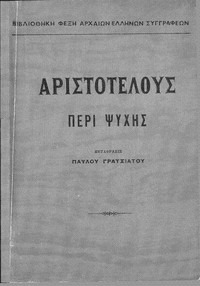
Περί Ψυχής by Aristotle
Read "Περί Ψυχής by Aristotle" Online
This book is available in the public domain. Start reading the digital edition below.
START READING FULL BOOKBook Preview
A short preview of the book’s content is shown below to give you an idea of its style and themes.
So, there's no plot in the usual sense—no characters or sword fights. Instead, Aristotle lays out an investigation. He starts by reviewing what other philosophers (like Plato) said about the soul, points out where he thinks they're confused, and then builds his own theory from the ground up.
The Story
Think of it as a detective story where the mystery is life itself. The 'suspects' are different kinds of souls: the 'nutritive' soul that makes plants grow, the 'sensitive' soul that lets animals feel and move, and the 'rational' soul that gives humans the power to think and reason. Aristotle argues these aren't separate ghosts in a machine; they're the very organizing principle of a living body. The soul is to the body what sight is to an eye—its function and purpose. He walks us through senses, imagination, and thought, trying to pin down what makes each of us a unified, living being.
Why You Should Read It
It’s humbling and mind-expanding. You start seeing his framework everywhere. That houseplant on your shelf? It has a soul, in Aristotle's terms, because it's actively growing and sustaining itself. Your cat chasing a laser pointer? That's its sensitive soul in action. It makes you appreciate the continuity of life. Reading it, you're directly wrestling with ideas that shaped Western science, philosophy, and even theology for centuries. It's not always easy, but the 'aha!' moments are worth it.
Final Verdict
This is for the curious reader who doesn't mind a bit of a mental workout. It's perfect for anyone interested in philosophy, the history of science, or big questions about life and consciousness. If you've ever wondered how ancient thinkers tackled the problems we still debate today, this is your foundational text. Skip it if you want a light narrative, but pick it up if you're ready to have a 2,300-year-old conversation with a genius.
There are no legal restrictions on this material. Use this text in your own projects freely.
Ava Jackson
1 year agoI was skeptical at first, but the pacing is just right, keeping you engaged. Worth every second.
Lisa Flores
10 months agoI was skeptical at first, but the arguments are well-supported by credible references. Truly inspiring.
Elizabeth Moore
6 months agoA must-have for anyone studying this subject.
Steven Torres
5 months agoSurprisingly enough, it challenges the reader's perspective in an intellectual way. Exactly what I needed.





Brian Lopez
5 months agoVery helpful, thanks.