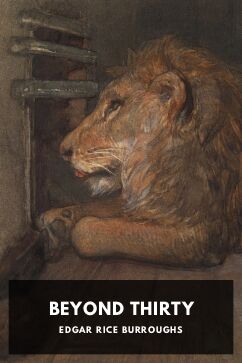
Beyond Thirty - Edgar Rice Burroughs

(12 User reviews)   3332
By Brenda Hill Posted on Jan 27, 2026
In Category - Bioethics
Edgar Rice Burroughs Edgar Rice Burroughs
English
Hey, I just finished this wild book you'd probably like. It's called 'Beyond Thirty' by Edgar Rice Burroughs, the guy who wrote Tarzan. Forget what you know about history. This story starts in 2137, but the world looks nothing like we expect. For 200 years, the Americas and Eurasia have been completely cut off from each other by a giant no-go zone called 'The Dead Belt.' No contact, no trade, nothing. The story follows Jefferson Turck, an American naval officer, whose ship gets damaged and drifts east of the forbidden longitude. He and his crew become the first Westerners in centuries to see what happened to Europe. And let me tell you, it's not pretty. They find a continent that's crumbled back to the Dark Ages, overrun by nature and ruled by savage tribes. It's a crazy 'what-if' adventure about rediscovering a lost world, full of sword fights, strange cultures, and one man trying to bridge a gap nobody remembers existed. If you like old-school adventure with a twist, this hidden gem is a blast.
Share

Read "Beyond Thirty - Edgar Rice Burroughs" Online

This book is available in the public domain. Start reading the digital edition below.

START READING FULL BOOK
Instant Access    Mobile Friendly

Book Preview

A short preview of the book’s content is shown below to give you an idea of its style and themes.

to check the laws of the country where you are located before using this ebook. Title: The Lost Continent Author: Edgar Rice Burroughs Release Date: July, 1994 [EBook #149] [Most recently updated: November 29, 2020] Language: English Character set encoding: UTF-8 *** START OF THIS PROJECT GUTENBERG EBOOK EBOOK THE LOST CONTINENT *** Produced by Judith Boss. HTML version by Al Haines. The Lost Continent by Edgar Rice Burroughs The Lost Continent was originally published under the title Beyond Thirty Contents CHAPTER I CHAPTER II CHAPTER III CHAPTER IV CHAPTER V CHAPTER VI CHAPTER VII CHAPTER VIII CHAPTER IX CHAPTER I. Since earliest childhood I have been strangely fascinated by the mystery surrounding the history of the last days of twentieth century Europe. My interest is keenest, perhaps, not so much in relation to known facts as to speculation upon the unknowable of the two centuries that have rolled by since human intercourse between the Western and Eastern Hemispheres ceased—the mystery of Europe’s state following the termination of the Great War—provided, of course, that the war had been terminated. From out of the meagerness of our censored histories we learned that for fifteen years after the cessation of diplomatic relations between the United States of North America and the belligerent nations of the Old World, news of more or less doubtful authenticity filtered, from time to time, into the Western Hemisphere from the Eastern. Then came the fruition of that historic propaganda which is best described by its own slogan: “The East for the East—the West for the West,” and all further intercourse was stopped by statute. Even prior to this, transoceanic commerce had practically ceased, owing to the perils and hazards of the mine-strewn waters of both the Atlantic and Pacific Oceans. Just when submarine activities ended we do not know but the last vessel of this type sighted by a Pan-American merchantman was the huge Q 138, which discharged twenty-nine torpedoes at a Brazilian tank steamer off the Bermudas in the fall of 1972. A heavy sea and the excellent seamanship of the master of the Brazilian permitted the Pan-American to escape and report this last of a long series of outrages upon our commerce. God alone knows how many hundreds of our ancient ships fell prey to the roving steel sharks of blood-frenzied Europe. Countless were the vessels and men that passed over our eastern and western horizons never to return; but whether they met their fates before the belching tubes of submarines or among the aimlessly drifting mine fields, no man lived to tell. And then came the great Pan-American Federation which linked the Western Hemisphere from pole to pole under a single flag, which joined the navies of the New World into the mightiest fighting force that ever sailed the seven seas—the greatest argument for peace the world had ever known. Since that day peace had reigned from the western shores of the Azores to the western shores of the Hawaiian Islands, nor has any man of either hemisphere dared cross 30°W. or 175°W. From 30° to 175° is ours—from 30° to 175° is peace, prosperity and happiness. Beyond was the great unknown. Even the geographies of my boyhood showed nothing beyond. We were taught of nothing beyond. Speculation was discouraged. For two hundred years the Eastern Hemisphere had been wiped from the maps and histories of Pan-America. Its mention in fiction, even, was forbidden. Our ships of peace patrol thirty and one hundred seventy-five. What ships from beyond they have warned only the secret archives of government show; but, a naval officer myself, I...

This is a limited preview. Download the book to read the full content.

Most of us know Edgar Rice Burroughs for creating Tarzan and John Carter of Mars, but he also wrote some fantastic 'what-if' stories. 'Beyond Thirty' is one of his best, and it feels surprisingly fresh even today.

The Story

The year is 2137. Two centuries earlier, a terrible war led the Americas to adopt a strict policy: no travel or communication east of the 30th longitude west of Greenwich (roughly through the Atlantic). This 'Dead Belt' became an uncrossable barrier. Jefferson Turck, captain of the American submarine Coldwater, is a loyal officer until a storm damages his vessel and pushes it beyond the forbidden line. He and his crew wash up on the shores of a forgotten Europe.

They discover a continent transformed. Great cities like London are crumbling ruins, reclaimed by forests. Humanity has splintered into primitive, warring tribes. The crew is captured, escapes, and gets caught up in local power struggles. Turck finds himself fighting for his life with a sword, falling for a fierce tribal princess, and racing against rival factions who see his advanced knowledge as either a miracle or a threat. His mission shifts from getting home to surviving in a world that has moved on without the West.

Why You Should Read It

This isn't just a simple adventure yarn. Burroughs uses his wild premise to ask real questions. What happens when civilizations lose touch? Can progress be undone? Turck is a great lead—a rational, modern man thrown into absolute chaos, forced to adapt or die. The action is constant and fun, but underneath, there's a melancholy look at what we could lose. It's about rediscovery, not as a conqueror, but as a stranger in a land that was once familiar. The world-building is vivid; you can almost smell the damp moss on the old cathedral stones.

Final Verdict

'Beyond Thirty' is a perfect read for fans of classic adventure, early science fiction, or anyone who loves a great 'lost world' story. If you enjoy the pacing of a Jules Verne novel or the frontier spirit of a Western, but set in a overgrown, post-collapse Europe, you'll have a great time. It's a short, fast-paced book that proves a good adventure story, with a clever hook and a relatable hero, never gets old.


🟢 Public Domain Notice

This text is dedicated to the public domain. It is now common property for all to enjoy.

Kimberly Johnson
1 year ago

A must-have for anyone studying this subject.

Brian Young
1 year ago

Good quality content.

Mary Anderson
1 year ago

Honestly, the clarity of the writing makes this accessible. This story will stay with me.

Mark Brown
1 year ago

After finishing this book, the flow of the text seems very fluid. Truly inspiring.

Ava Wright
1 year ago

This book was worth my time since the atmosphere created is totally immersive. I will read more from this author.

5
5 out of 5 (12 User reviews )

Add a Review

Your Rating *
There are no comments for this eBook.
You must log in to post a comment.
Log in


Related eBooks