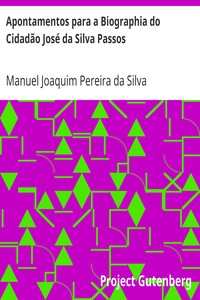
Apontamentos para a Biographia do Cidadão José da Silva Passos by Pereira da Silva

(17 User reviews)   5343
By Brenda Hill Posted on Jan 13, 2026
In Category - Bioethics
Pereira da Silva, Manuel Joaquim Pereira da Silva, Manuel Joaquim
Portuguese
Okay, so you know how most old biographies feel like reading a marble statue's plaque? This one is different. 'Apontamentos para a Biographia do Cidadão José da Silva Passos' isn't just a dry list of dates. It's a messy, fascinating, and sometimes frustrating attempt to pin down a ghost. José da Silva Passos was a huge deal in 19th-century Portuguese politics—a liberal revolutionary, a key figure in the September Revolution. But by the time Pereira da Silva sat down to write about him, the man was already slipping into legend. The book feels like a detective story where the clues are fading. The author is literally scrambling, gathering notes ('apontamentos'), because a full, clean biography might already be impossible. The real conflict here isn't in the subject's life, but in the writer's struggle to capture it before it disappears forever. It's about memory versus history, and how we build the stories of our heroes after they're gone. If you like seeing the seams in history, this is a weird and compelling little time capsule.
Share

Read "Apontamentos para a Biographia do Cidadão José da Silva Passos by Pereira da Silva" Online

This book is available in the public domain. Start reading the digital edition below.

START READING FULL BOOK
Instant Access    Mobile Friendly

Book Preview

A short preview of the book’s content is shown below to give you an idea of its style and themes.

to check the laws of the country where you are located before using this ebook. Title: Bêtes et gens qui s'aimèrent Author: Claude Farrère Release Date: June 30, 2018 [EBook #57420] Language: French Character set encoding: UTF-8 *** START OF THIS PROJECT GUTENBERG EBOOK BÊTES ET GENS QUI S'AIMÈRENT *** Produced by Winston Smith. Images provided by The Internet Archive. CLAUDE FARRÈRE Bêtes et gens qui s'aimèrent ERNEST FLAMMARION 26, Rue Racine, 26 Quinzième mille * * * * * _Il a été tiré de cet ouvrage:_ _trois cent cinquante exemplaires sur papier de Hollande,_ _soixante-cinq exemplaires sur papier de Chine,_ _cinq cent quarante exemplaires sur papier vélin pur fil Lafuma,_ _tous numérotés,_ _et vingt-cinq exemplaires sur papier de luxe,_ _hors numérotaqe,_ _tous signés et parafés de la main de l'auteur,_ _imprimés spécialement pour ses amis et lui._ * * * * * Bêtes et gens qui s'aimèrent CLAUDE FARRÈRE Bêtes et gens qui s'aimèrent PARIS ERNEST FLAMMARION, ÉDITEUR 26, RUE RACINE, 26 * * * * * Tous droits de traduction, d'adaptation et de reproduction réservés pour tous les pays Droits de traduction et de reproduction réservés pour tous les pays. Copyright 1920, by ERNEST FLAMMARION * * * * * I LES BÊTES 1.--UNE VIE _A Guy de Maupassant._ Le commencement de l'histoire, je ne le sais pas. Rien ne m'oblige, d'ailleurs, à confesser mon ignorance, sauf ma loyauté d'historien. Mais je préfère en vérité perdre la face qu'abuser impudemment mes lecteurs et trancher au hasard le problème des sept villes qui pourraient se disputer l'honneur d'avoir donné le jour à mon héroïne, encore qu'elle ne soit en aucune façon descendante d'Homère. Je suppose qu'elle naquit à Paris; je suppose même que ses père et mère devaient loger dans l'aristocratique arrondissement numéro sept; non loin de ces Invalides qui groupent encore, autour de leur dôme splendide, tous les plus vieux noms, toutes les plus vieilles demeures de notre noblesse de France... Je suppose tout cela; mais ce ne sont que des suppositions. Et je n'affirme rien, sauf que la dite héroïne arriva chez moi, par une belle matinée de juin ou de juillet, dans une litière,--comme il sied à toute personne de qualité;--et que cette litière était un panier: parce que la susdite héroïne était une chatte. Une chatte ... j'exagère! Disons plutôt qu'elle le devint. Car, dans ce premier instant qui vit les sentiers de nos deux existences s'approcher l'un de l'autre et se prolonger parallèlement, la chatte en question n'était qu'un petit, petit, tout petit chat, qu'un avorton de chaton. Et bien malin qui l'eût affirmée chatte plutôt que chat, ou le contraire! Cela n'était qu'une boule de poils. Et cela venait d'arriver chez moi, ainsi que j'ai dit, dans un panier. Oté le couvercle du contenant, je vis le contenu. C'était vivant, cela remuait. Et, tout de suite, cela s'escrima des quatre griffes pour sortir; et, ma foi, cela y parvint. En ce temps-là, je venais d'éprouver trois pertes les plus douloureuses du monde: ma grande chatte noire _Messaline_; sa fille _Tigresse_, dont le nom révélait la robe; et son fils _Petite Vierge_, une bestiole tricolore qui avait débauché coup sur coup tout ce que l'immeuble comptait de jeunes chattes bien nées, avant que lui-même eût eu l'âge légal de jeter sa propre gourme ... trois charmantes bêtes qui se partageaient mon cœur, comme a dit le poète: _tous l'ayant tout entier!..._ Tout cela était mort, dans le temps que je prends pour l'écrire. _Tigresse_ et _Petite Vierge_, sorties ensemble un matin du logis, le soir n'y étaient pas rentrées; et voilà pour elles; on...

This is a limited preview. Download the book to read the full content.

Let's be clear from the start: this isn't a slick, modern biography. The title gives it away—'Apontamentos' means 'Notes' or 'Jottings.' Pereira da Silva isn't presenting a polished final product; he's showing us his workshop.

The Story

The book is an effort to document the life of José da Silva Passos, a central figure in Portugal's liberal struggles of the 1800s. We follow his journey from a young man caught up in revolutionary fervor to a seasoned politician navigating the turbulent waters after the September Revolution of 1836. But the 'plot' is secondary to the process. The narrative is built from fragments: personal recollections, official documents, letters, and hearsay. You can feel Pereira da Silva racing against time, trying to assemble a coherent picture from pieces that don't always fit. It's less a straight line and more a mosaic being assembled before your eyes.

Why You Should Read It

This is where the book gets interesting for me. Its value isn't just in what it says about Silva Passos, but how it tries to say it. You get a real sense of how history was written in that era—personal, partisan, and urgent. The author's voice is present, sometimes exasperated, always determined. You see his choices, his gaps, his biases. It makes Silva Passos feel more human, not because we learn every intimate detail, but because we see how hard it is to recover a single human life from the noise of the past. It turns the subject from a historical monument back into a man, blurred and contested.

Final Verdict

This is a niche pick, but a rewarding one. It's perfect for history buffs who are tired of textbooks and want to see the raw material of biography. If you enjoy meta-narratives about how stories are constructed, or if you're fascinated by 19th-century Portugal, you'll find this incredibly engaging. But if you want a straightforward, easy-to-follow life story, you might find it rough going. Think of it as an archaeological dig in book form—you're there with the historian, brush in hand, carefully uncovering the past, one fragile piece at a time.


📢 Copyright Free

The copyright for this book has expired, making it public property. It is now common property for all to enjoy.

Ava Rodriguez
1 year ago

Recommended.

Robert Williams
2 months ago

Perfect.

Liam Thompson
2 years ago

From the very first page, the pacing is just right, keeping you engaged. Truly inspiring.

Lisa Young
5 months ago

Text is crisp, making it easy to focus.
Logan Taylor
1 year ago

I was skeptical at first, but the content flows smoothly from one chapter to the next. This story will stay with me.

5
5 out of 5 (17 User reviews )

Add a Review

Your Rating *
There are no comments for this eBook.
You must log in to post a comment.
Log in


Related eBooks