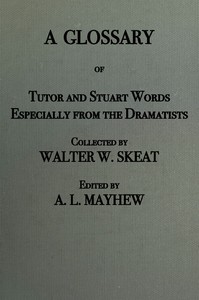
A glossary of Tudor and Stuart words, especially from the dramatists by Skeat

(11 User reviews)   3692
By Brenda Hill Posted on Jan 13, 2026
In Category - Medical Research
Skeat, Walter W. (Walter William), 1835-1912 Skeat, Walter W. (Walter William), 1835-1912
English
Hey, have you ever tried reading Shakespeare or one of those old plays and gotten totally stuck on the words? I'm not talking about 'thou' and 'thee' – I mean the real head-scratchers. Like, what on earth does 'firk' mean? Or 'quatch'? This book is like having a secret decoder ring for the English language from 400 years ago. It's not a dry dictionary – it's a collection of words that were once common but have completely vanished or changed beyond recognition. The real mystery isn't just what the words meant, but why we stopped using so many of them. It feels like discovering a hidden layer of our own language, full of strange, funny, and sometimes surprisingly useful terms that our ancestors tossed around. If you've ever been curious about the raw, vibrant, and often bizarre English of the Tudor and Stuart eras, this glossary is your direct line to the past. It turns reading old texts from a chore into a treasure hunt.
Share

Read "A glossary of Tudor and Stuart words, especially from the dramatists by Skeat" Online

This book is available in the public domain. Start reading the digital edition below.

START READING FULL BOOK
Instant Access    Mobile Friendly

Book Preview

A short preview of the book’s content is shown below to give you an idea of its style and themes.

some old play.’ This story explains the genesis of this book. Like John Gilpin’s wife, it seems that though on pleasure he was bent, he had a frugal mind. He did not forget business. When reading Ben Jonson or Beaumont and Fletcher he had pencil in hand, and whenever he came to a word that might prove a stumbling-block to the general reader, he noted that word, and eventually wrote it on a separate slip (note-paper size) with exact reference and explanation. In July, 1911, in Oxford, when we were together for the last time, the professor told me about the book he was preparing—mainly consisting of the words he had collected in reading the Tudor and Stuart dramatists. He did not intend it to be a big book. When I asked whether it would contain quotations like Nares’ Glossary, he said it would contain only a few quotations, and those short ones, and would consist mostly of explanations and references, with brief etymologies. I heard no more of the book during his lifetime. But frequent letters passed between us on the etymologies of English words, many of which he was meeting with in the material he was collecting. On October 6, 1912, that eager, enthusiastic spirit passed away, to the regret of all who work in the field of English philology, of all who love the English tongue, wherever on this habitable globe they may chance to live. Not long after, in November, I heard from Mrs. Skeat that her husband had left material for a Glossary of Rare Words, in slips amounting to nearly 7,000, arranged in alphabetical order, and that Professor Skeat’s executors would be very glad if I would be able to edit and prepare the work for publication. I agreed to do this, on condition that the executors should ask the advice of a pupil of Dr. Skeat, an eminent English scholar, and also, of course, that the Delegates of the Clarendon Press would consent to the arrangement. On December 4 I received a letter from the Clarendon Press, informing me that the Delegates accepted my offer. A day or two after the box containing the MS. arrived, and on December 9 I addressed myself to the task. With the exception of a short intermission in July, the work has had my continuous and undivided attention for one year. On examination of the MS. it appeared that, although Professor Skeat had arranged the material in the form of a Glossary, he had not put the finishing touches to the book (many slips were practically duplicates or triplicates), and had not even finally limited the scope: the title of the book was not settled. And now it will be proper to state as clearly as possible what the Editor thought it his duty to do in preparing his friend’s work for publication. In the first place he did not think that it fell within his province to make any considerable addition to the Word-list. The Vocabulary remains much as Professor Skeat left it. But it was found necessary, in going over the work, to make additions in many articles, in order to explain the history of the word, or to illustrate its meaning; connecting links had to be supplied, where the meanings of a word apparently had no connexion with one another. In this part of the work the Editor found great help in the New English Dictionary; and it will be seen that there is hardly a page of this book on which there does not occur the significant abbreviation (NED.). With the same help...

This is a limited preview. Download the book to read the full content.

So, what exactly is this book? It's not a novel with a plot. Think of it as a field guide, but instead of birds or plants, it catalogs the wild and wonderful words used between about 1485 and 1714, with a special spotlight on the playwrights of the time. Walter Skeat, a giant in the study of word origins, didn't just list definitions. He gathered thousands of terms from plays, pamphlets, and other writings that had fallen out of daily use. The 'story' here is the story of the English language itself, caught in a period of dramatic change and incredible creativity.

The Story

The book is organized like a dictionary, from A to Z. You'll find entries for words that make you laugh (a 'gundygut' was a glutton), words that sound magical ('elritch' meant fairy-like or haunted), and words that are just plain confusing ('ake' was an old form of 'ache'). Skeat often includes a short quote from a writer like Shakespeare, Ben Jonson, or John Fletcher to show the word in action. There's no narrative, but there is a clear mission: to rescue these words from obscurity and help modern readers unlock the full meaning—and humor—of classic texts.

Why You Should Read It

I love this book because it makes the past feel alive and noisy. It reminds you that language isn't set in stone. People back then had slang, insults, and silly words just like we do. Finding out that 'kicksy-wicksy' was a playful (or sometimes annoyed) term for a wife, or that 'smell-smock' was a word for a lecherous man, adds a layer of humanity to history. It's not just about kings and queens; it's about how regular people joked, argued, and described their world. Dipping into this glossary gives you a new appreciation for the writers of the time, who had this huge, colorful palette of words to paint with.

Final Verdict

This is a perfect book for curious minds, not just academics. If you're a fan of Shakespeare, Renaissance drama, or historical fiction set in this period, keep this on your shelf as an essential companion. It's also great for word nerds, writers looking for unique vocabulary, or anyone who enjoys the oddities of history. It's not a book you read cover-to-cover, but one you browse. Open it to any page, and you're guaranteed to find something fascinating, funny, or wonderfully strange. A true gem for unlocking the voices of the past.


✅ No Rights Reserved

This text is dedicated to the public domain. Feel free to use it for personal or commercial purposes.

William Sanchez
1 year ago

Without a doubt, the arguments are well-supported by credible references. Absolutely essential reading.

Oliver King
1 year ago

After finishing this book, it challenges the reader's perspective in an intellectual way. Definitely a 5-star read.

Amanda Rodriguez
1 year ago

Without a doubt, the plot twists are genuinely surprising. I couldn't put it down.

Mark Walker
10 months ago

Great read!

Margaret Sanchez
4 months ago

Used this for my thesis, incredibly useful.

5
5 out of 5 (11 User reviews )

Add a Review

Your Rating *
There are no comments for this eBook.
You must log in to post a comment.
Log in


Related eBooks