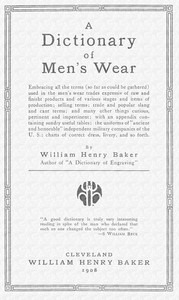
contrary to most dictionaries, encyclopedias and the like, interesting. Altho the title specifies “men’s wear”, the book broadly covers many items of women’s wear (as many fabrics, etc., are common to both sexes), and except that items of strictly women’s wear have been omitted, might have been entitled “A Dictionary of Apparel”, and should, therefore, be of quite as much interest to the straight drygoods merchant as to the modern clothier. The definitions are not tiresomely long—not any of them—but all are of sufficient length to cover essentials and are accurate and reliable; and, altho the dictionary is somewhat encyclopedic, it is not intended that it shall take the place of any encyclopedia. A feature of its forerunner that may be appreciated is that many of the less important and more obvious terms are dismist quite briefly or else freely or facetiously handled—enough so to induce one to search the pages for these alone. Obviously, no hard and fast rules could be set to govern the work. Each term had to be considered in itself and explained so clearly, without waste (or skimping) of words, as to be understandable without the aid of pictures. That there has been no necessity for illustrations and that the book has been otherwise brightened without them the author considers somewhat of an achievment. In a word, it has been the aim of the author to make simply a handy reference book, “popular” rather than learned, helping one over transient needs, leaving the wearying technical dissertations to text books, encyclopedias, etc. If this has been accomplisht, there is great cause for satisfaction to WILLIAM HENRY BAKER Cleveland, 1908 Memorandum Please don’t be provoked by the use of “simplified spelling.” It helpt me cram much more in the compass of this book than could have been done with the use of some of our superannuated forms. Besides, simplification is the order of the day, and we might as well get used to it, every one of us. And, again, only the less jarring and those surest of early adoption have been used: there’s a concession to conservatism and “the conventions”. Neither permit the abbreviation of repetitions of index-words to the initial letters thereof to confuse you. The eye catches the sense and simplicity of the scheme quickly enough (the brain should be no less nimble)—and the eye must not be offended. Besides, this has saved me more space than “simplified spelling”. Please notice, further, that this is not a pronouncing dictionary. Most people in the trade don’t need this feature, thru daily familiarity with the terms, even tho they may not thoroly understand them—which is nothing unusual. And so, to keep as many “high-browed” features out of the way as was possible, and to make this just a handy look-into book for everyday folks (such a book as I have longed for for my own use) pronunciation, grammar-classing, and such like devices of the weary big-books were deemed superfluous and dropt. You will have to go to them, anyway, on some subjects which this book treats briefly—why tire you beforehand?—W. H. B. Authorities Consulted New International Encyclopedia Standard Dictionary Cole’s “Encyclopedia of Dry Goods” Giles’ “History of Cutting in England” Planche’s “History of Costume” Mrs. Earle’s “Two Centuries of Costume in America”, “Costume of Colonial Days”, etc. Mrs. Aria’s “Costume: Fanciful, Historical and Theatrical” Mitchell’s “New Standard Coat System” Croonborg’s “Supreme System for Men’s Garments” Baker’s “Clothes Dictionary” Beck’s “Gloves: Their Annals and Associations” Boutell’s “Arms and Armour” Rimmel’s “The Book of Perfumes” Edwards’ “History and Poetry of Finger Rings” Hamersly’s “Naval Encyclopedia” “Clothes and the...
This is a limited preview. Download the book to read the full content.




Robert Gonzalez
2 years agoFinally found time to read this!